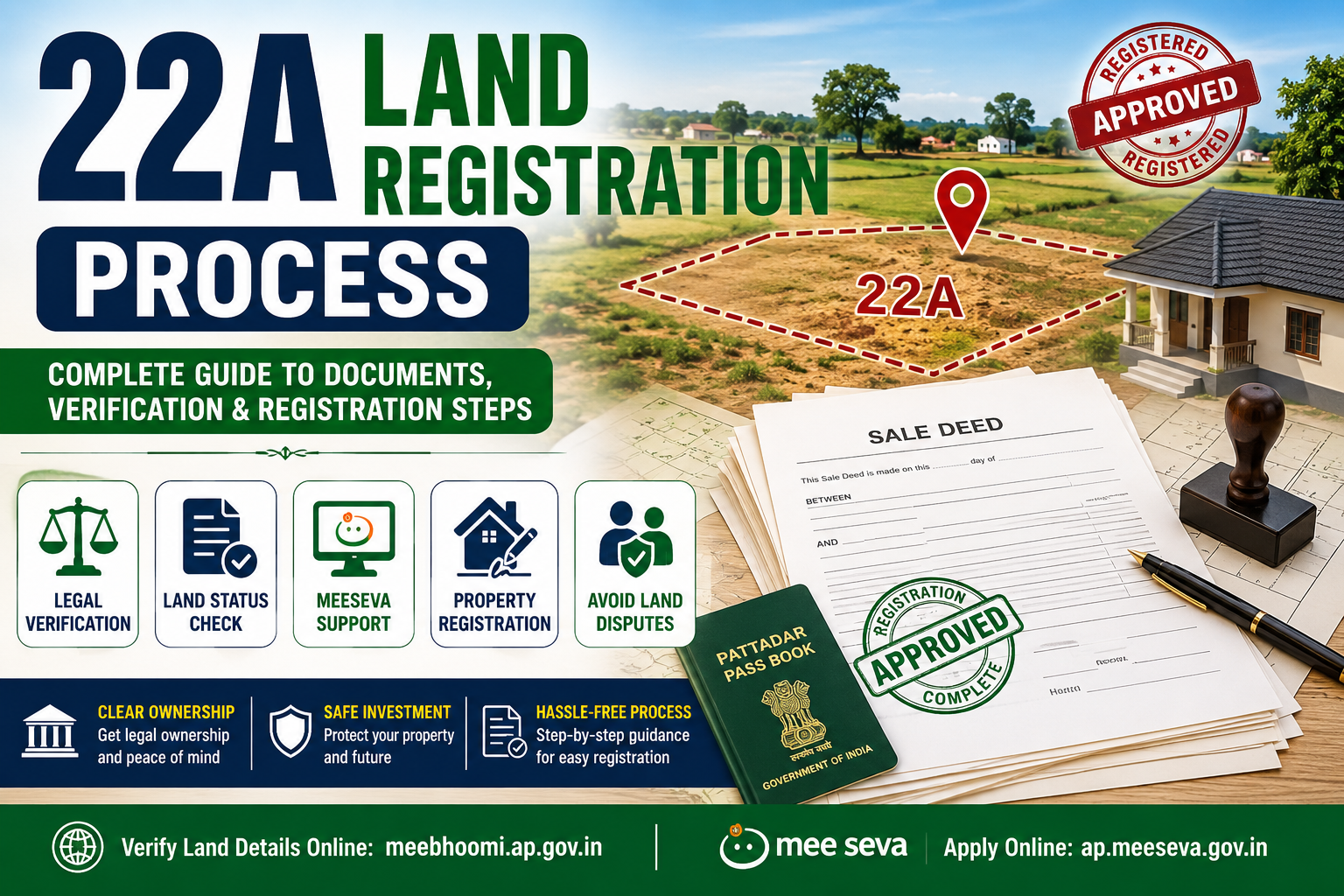

Many landowners in Andhra Pradesh face difficulties when they discover that their property falls under the 22A prohibited list. In such cases, land registration may not be possible until the issue is resolved through verification and approval by the concerned authorities.
Understanding the 22A Land Registration Process is important for buyers, sellers, and property owners. This guide explains what 22A land is, how to check land status, required documents, common reasons for rejection, and the process for removing land from the prohibited list.
22A Land Registration Process 2025 Overview
| Particulars | Details |
|---|---|
| Process Name | 22A Land Registration Process |
| State | Andhra Pradesh |
| Purpose | Verification of Restricted Land |
| Registration Allowed | Subject to Verification |
| Verification Authority | Revenue & Registration Departments |
| Status Check | Online and Offline |
| Documents Required | Land and Ownership Records |
| Applicable Lands | Prohibited Category Lands |
What Is 22A Land?
Section 22A of the Registration Act relates to categories of properties that are included in the prohibited properties list maintained by the Registration Department. Registration of such properties may be restricted until the competent authorities complete verification or remove the restriction.
Common categories listed under 22A restrictions include Government lands, Assigned lands, Endowment lands, Wakf properties, Forest lands, Ceiling Surplus lands, and other properties notified by competent authorities.
How to Check Whether Land Is Under 22A?
- Visit MeeBhoomi Portal.
- Select Land Records.
- Enter District, Mandal, Village.
- Enter Survey Number.
- Check ownership and land classification.
- Verify whether the property appears in prohibited/restricted category records.
➤ Read Also: Grama Khantam Land Registration Process: Documents, Eligibility & Registration Guide
Online Verification
- Check land records through official revenue portals.
- Verify survey number details.
- Review ownership and classification records.
Registration Department Verification
- Visit the local Sub-Registrar Office.
- Request property status verification.
- Confirm whether the survey number appears in the prohibited list.
Revenue Department Verification
- Approach the Tahsildar or Revenue Office.
- Verify land classification records.
- Check for government claims or restrictions.
Documents Required for 22A Verification
Applicants may need the following documents:
- Aadhaar Card
- Pattadar Passbook
- Title Deed
- Sale Deed Copy
- Encumbrance Certificate (EC)
- Survey Number Details
- Revenue Records
- Property Tax Receipts
- Identity Proof
- Address Proof
Additional documents may be requested depending on the nature of the property.
➤ Related Farmer Guide: Raithu Bharosa Scheme 2026: Eligibility, Benefits & Payment Status
Common Reasons Why Land Is Added to 22A List
- Government ownership disputes
- Assigned land violations
- Wakf property claims
- Endowment department ownership
- Forest land classification
- Court litigation
How to Check 22A Status Online
- Open MeeBhoomi portal.
- Select Land Records.
- Enter Survey Number.
- Select District, Mandal and Village.
- Verify land classification.
- Check prohibited property status.
Before Buying 22A Land
- Verify EC (Encumbrance Certificate)
- Check Survey Number
- Verify Pattadar Passbook
- Confirm Court Case Status
- Check Revenue Records
- Verify 22A Status
How to Check 22A Land Through Survey Number
Property owners can verify 22A status by using the survey number through MeeBhoomi records, revenue records, and Sub-Registrar Office verification. Survey number verification is one of the most reliable methods for identifying whether a property is included in the prohibited properties list.
Common 22A Land Categories in Andhra Pradesh
| Category | Status |
|---|---|
| Government Land | Restricted |
| Assigned Land | Restricted/Conditional |
| Wakf Land | Restricted |
| Endowment Land | Restricted |
| Forest Land | Restricted |
| Court Dispute Land | Subject to Orders |
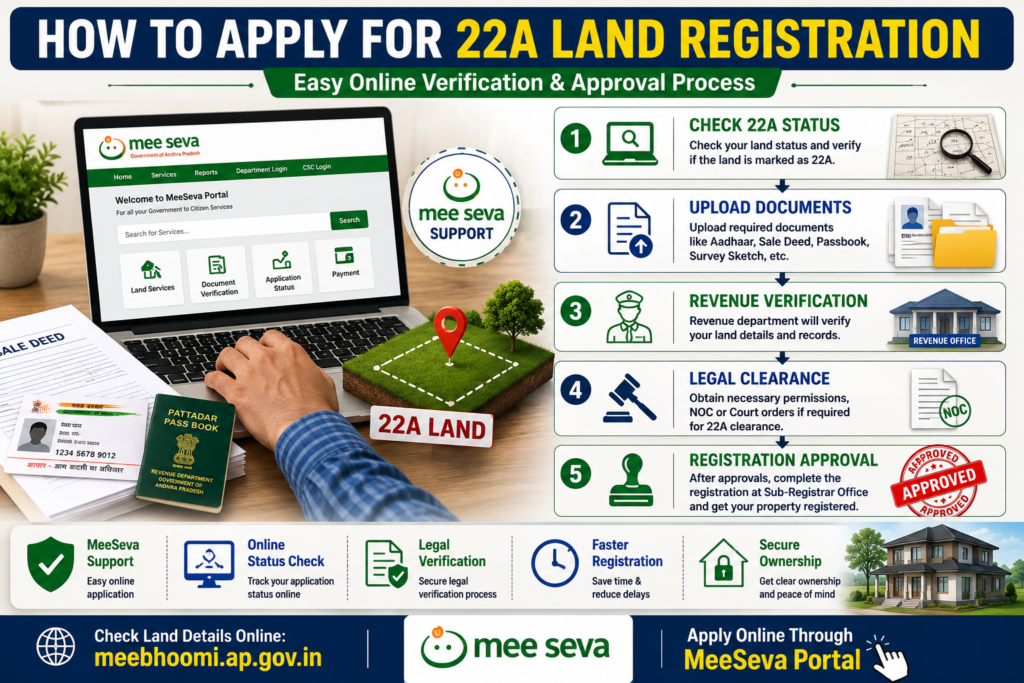
How to Apply for 22A Land Verification?
Property owners seeking verification may follow these general steps:
Step 1: Collect Property Documents
Gather all ownership and revenue records.
Step 2: Submit Application
Submit the required request to the concerned authority.
Step 3: Revenue Verification
Officials verify ownership records and land classification.
Step 4: Field Inspection
Authorities may conduct physical verification if required.
Step 5: Report Submission
Verification reports are prepared and reviewed.
Step 6: Final Decision
Authorities determine whether the land remains under restriction or qualifies for removal from the prohibited list.
➤ Check Also: PM-KISAN Scheme 2026: Registration, Beneficiary Status, eKYC & ₹6,000 Farmer Benefits
Common Reasons Why Registration Is Rejected
Land registration applications may be rejected for several reasons:
- Land included in the 22A prohibited list.
- Ownership disputes.
- Pending court cases.
- Survey number mismatch.
- Missing title documents.
- Government ownership claims.
- Revenue record discrepancies.
- Encroachment issues.
- Incomplete verification.
Applicants should ensure all records are accurate before initiating registration.
Difference Between 22A Land and Normal Patta Land
| Feature | 22A Land | Normal Patta Land |
|---|---|---|
| Registration | Restricted | Allowed |
| Government Approval | Required | Usually Not Required |
| Legal Risk | Higher | Lower |
| Sale Registration | Conditional | Regular Process |
Can 22A Land Be Registered?
Generally, land included in the prohibited list cannot be registered through the normal registration process.
Registration may become possible only after:
- Verification by competent authorities.
- Removal from the prohibited list where applicable.
- Clearance from the concerned departments.
- Completion of prescribed legal procedures.
The final decision depends on official verification and government records.
How to Remove Land from the 22A List?
If a property has been incorrectly included in the 22A prohibited list, the landowner may apply for removal through the concerned Revenue Authorities.
The process generally involves:
Step 1: Submit Application to Tahsildar
Landowner should submit a representation along with ownership documents, Pattadar Passbook, title records, and supporting evidence.
Step 2: Revenue Inquiry
Revenue officials verify ownership history, land classification, mutation records, and government claims related to the property.
Step 3: Survey Verification
Field-level inspection and survey verification may be conducted to confirm the actual status, boundaries, and classification of the land.
Step 4: RDO Examination and Recommendation
The Revenue Divisional Officer (RDO) reviews the verification reports and may recommend removal if the land does not fall under restricted categories.
Step 5: Approval by Competent Authority
In eligible cases, approval may be granted by the District Collector or other competent authority as per applicable rules.
Step 6: Updating Prohibited Property Records
After approval, the property may be removed from the 22A prohibited list, and registration records are updated accordingly.
Important: Removal from the 22A list is not automatic. Authorities approve requests only after verifying ownership records, survey details, revenue documents, and applicable legal provisions.
Common Issues Faced by Landowners
Property owners frequently encounter the following issues:
- Old survey record discrepancies.
- Inheritance record updates pending.
- Incorrect land classification.
- Missing mutation entries.
- Court litigation.
- Government ownership claims.
Resolving these issues early may help avoid registration delays.
Before Purchasing Land, Verify These Details
Buyers should always verify:
- Survey number records.
- Ownership details.
- Encumbrance Certificate.
- Revenue records.
- Property boundaries.
- Court case status.
- 22A prohibition status.
- Registration eligibility.
Proper verification can reduce future legal risks.
➤ Read More: Annadatha Sukheebhava Scheme 2025: ₹20,000 Financial Support for Farmers
Official Resources
| Action | Link |
|---|---|
| Andhra Pradesh Government Portal | Visit Website |
| Registration Department | Open Portal |
| MeeBhoomi Land Records | Check Land Records |
| AP MeeSeva Services | Access Services |
Frequently Asked Questions (FAQs)
1. What is 22A land?
22A land refers to properties included in the prohibited list where registration restrictions apply under government rules.
2. How can I check if my land is under 22A?
You can verify the survey number through revenue records, MeeBhoomi records, or the local Sub-Registrar Office.
3. Can 22A land be sold?
Registration may not be permitted while the land remains in the prohibited list. Clearance may be required before registration.
4. What documents are required for verification?
Aadhaar Card, Pattadar Passbook, Title Deed, EC, Survey Number Records, and related property documents may be required.
5. How long does 22A verification take?
Verification timelines may vary based on district, survey verification requirements, ownership records, and field inspections. In complex cases involving disputes or missing records, additional time may be required before a final decision is issued.
6. Can land be removed from the 22A list?
Eligible properties may be removed after verification and approval by the concerned authorities.
7. Can I buy 22A land?
Buyers should verify the reason for inclusion in the 22A list before proceeding. Registration restrictions may apply until the issue is resolved through the concerned authorities.
Key Takeaways
- 22A land falls under restricted registration categories.
- Buyers should verify land status before purchasing property.
- Survey number verification is extremely important.
- Revenue and registration records must match.
- Registration may not be possible while restrictions remain active.
- Proper documentation helps avoid delays.
- Official government records should always be considered final.
Conclusion
The 22A Land Registration Process plays a critical role in preventing registration of restricted properties and protecting government and public land records. Buyers and landowners should carefully verify survey details, ownership records, and prohibition status before proceeding with any property transaction. Conducting proper verification through official channels can help avoid legal disputes, registration rejection, and future complications.

Venkatesh is the Content Lead and Researcher at UNQ Information. He researches government schemes, pension programs, citizen services, and welfare initiatives related to Andhra Pradesh and Telangana. He regularly publishes updates and educational content to help readers understand eligibility criteria, required documents, application procedures, benefit details, and important government announcements in a simple and easy-to-understand format.