

Financial assistance schemes have become an important support system for farmers facing rising cultivation costs, fluctuating market prices, labour shortages, and climate-related risks. In Andhra Pradesh, farmer welfare assistance has evolved over the years through various programs designed to provide direct financial support to eligible farming families.
Many farmers continue searching for “Raithu Bharosa Scheme 2026” to understand eligibility, payment amounts, beneficiary verification, application requirements, and payment status updates. However, one of the biggest challenges is finding accurate information instead of outdated or copied content.
This guide explains the latest farmer assistance framework, payment structure, verification process, common payment issues, and practical steps farmers should follow to ensure they receive benefits without delays.
Quick Scheme Overview
| Particulars | Details |
|---|---|
| Scheme Name | Raithu Bharosa / Farmer Assistance Program |
| Benefit Type | Direct Financial Assistance |
| Payment Mode | Direct Benefit Transfer (DBT) |
| Beneficiary Verification | Aadhaar, Bank Account, Land Records |
| Required Documents | Aadhaar, Bank Passbook, Land Documents |
| e-KYC Required | Yes |
| Official Support | State Government + PM-KISAN |
What Is Raithu Bharosa Scheme?
Raithu Bharosa was introduced as a farmer support initiative aimed at reducing the financial burden of cultivation. The scheme provided direct financial assistance to eligible farmer families through bank accounts using the Direct Benefit Transfer (DBT) system.
Over time, Andhra Pradesh’s farmer assistance programs have undergone policy changes. The current support structure is integrated with PM-KISAN under the Annadata Sukhibhava framework, providing annual financial support to eligible farmers. Public government announcements indicate annual assistance of up to ₹20,000 per eligible farmer family. This includes both state and central government contributions.
Annual Financial Assistance
According to official government announcements made during the launch of the program:
- Total annual support: ₹20,000
- State Government contribution: ₹14,000
- PM-KISAN contribution: ₹6,000
- Payments released through Direct Benefit Transfer (DBT)
- Assistance distributed through multiple installments during the year
The objective is to ensure that farmers receive support before important agricultural activities such as sowing, fertilizer purchase, irrigation planning, and crop maintenance.
➤ Check Also: NTR Baby Kit Scheme 2025: Eligibility, Benefits & Distribution Details
Why Financial Support Matters for Farmers
Many agricultural households face significant seasonal expenses before generating income from harvested crops.
Common cultivation expenses include:
- Seeds
- Fertilizers
- Pesticides
- Labour charges
- Irrigation expenses
- Equipment maintenance
- Transportation costs
Government financial support helps reduce dependence on informal borrowing and improves working capital availability during critical crop seasons.
Who Is Not Eligible for the Scheme?
Not every applicant qualifies for farmer assistance.
Applicants may become ineligible if:
- Agricultural land records cannot be verified
- Aadhaar authentication fails
- Duplicate beneficiary records are detected
- Required e-KYC remains incomplete
- Bank account details are invalid
- Applicant does not satisfy government eligibility conditions
Key Highlights
- Annual support up to ₹20,000
- Payments transferred through DBT
- Verification through Aadhaar and land records
- Millions of farming families covered
- Integration with PM-KISAN support
Eligibility Criteria
Eligibility is generally determined through government verification systems that examine multiple records before approving beneficiaries.
Key factors considered include:
Land Ownership Verification
Land ownership records are matched against revenue department databases to verify eligibility.
Aadhaar Authentication
Beneficiary identity is verified through Aadhaar-linked records.
Bank Account Validation
The registered bank account must be capable of receiving Direct Benefit Transfer payments.
e-KYC Compliance
Beneficiaries may be required to complete Aadhaar-based e-KYC verification.
Database Matching
Government systems cross-check records to eliminate duplicate beneficiaries and payment errors.
Eligibility may change according to government notifications, so applicants should always verify current rules before relying on scheme information.
Documents Required
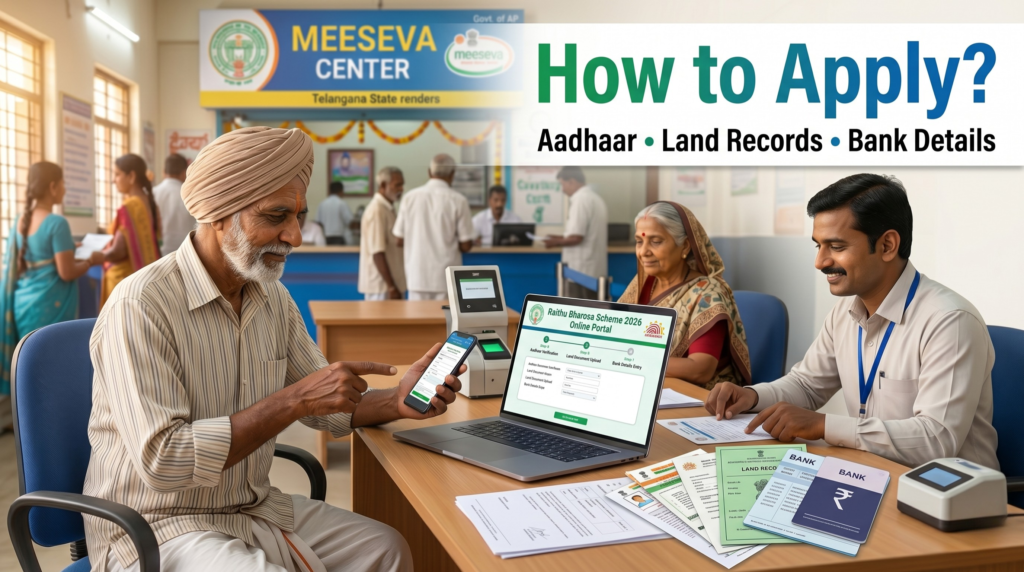
Farmers should keep the following documents ready:
- Aadhaar Card
- Bank Passbook
- Mobile Number Linked to Aadhaar
- Pattadar Passbook
- Land Ownership Documents
- Residence Proof
- Passport Size Photograph
- e-KYC Details (where applicable)
Keeping records updated significantly reduces the chances of verification failure.
➤ Related Scheme: Adabidda Nidhi Scheme 2025: Eligibility, Benefits, Documents & Latest Updates
Expected Payment Schedule
Financial assistance is generally released in multiple installments throughout the year. The exact payment schedule depends on government announcements and budget allocations.
Farmers should regularly monitor official notifications to know:
- Installment release dates
- Beneficiary verification deadlines
- e-KYC requirements
- Payment credit status
Payments are usually processed through the Direct Benefit Transfer (DBT) system after successful verification of beneficiary records.
How DBT Payments Reach Farmers
Many farmers know that money reaches their bank account directly, but few understand the process behind it.
Step 1: Beneficiary verification
Step 2: Aadhaar authentication
Step 3: NPCI account mapping
Step 4: Payment approval
Step 5: Fund transfer through DBT
Step 6: Credit to beneficiary account
This process helps reduce fraud and ensures transparency.
Farmer Checklist
Before every payment cycle:
✓ Aadhaar linked to bank account
✓ Active mobile number
✓ Updated land records
✓ Completed e-KYC
✓ Active savings account
✓ Correct beneficiary details
Completing these checks can help avoid payment delays.
➤ Check Also: Digital Lakshmi Scheme 2026: Digital Entrepreneurship Support for Women
Important Official Links
| Action | Link |
|---|---|
| PM-KISAN Official Portal | Visit Portal |
| Check PM-KISAN Beneficiary Status | Check Status |
| Andhra Pradesh Government Portal | Visit Website |
| National Government Services Portal | Open Portal |
| Farmer Welfare Portal | Visit Portal |
| Aadhaar Official Website | Open UIDAI |
| DBT Bharat Portal | Check DBT Details |
Important: Farmers should use only official government portals for beneficiary verification, payment status checking, Aadhaar updates, and scheme-related information. Avoid sharing personal details on unofficial websites.
Typical Payment Cycle
Stage 1 – Beneficiary verification
Stage 2 – Data validation
Stage 3 – Approval process
Stage 4 – Payment release
Stage 5 – Bank account credit
Actual timelines may vary according to government schedules.
Beneficiary Verification Process
One area rarely explained by most websites is how verification actually works.
Before releasing funds, authorities conduct multiple checks.
Step 1: Aadhaar Verification
Identity details are verified through Aadhaar-linked databases.
Step 2: Bank Account Mapping
Authorities confirm that the beneficiary account is active and mapped correctly for DBT payments.
Step 3: Land Record Verification
Revenue databases are checked to validate agricultural land ownership details.
Step 4: Duplicate Screening
Systems identify duplicate beneficiaries or multiple registrations linked to the same person.
Step 5: Final Approval
Only after successful verification are beneficiaries included in the final payment list.
Government reports show that large-scale verification exercises were conducted to ensure benefits reach genuine farmers. More than 47 lakh farmer records underwent scrutiny, while issues such as inactive bank accounts and missing Aadhaar-bank linkage were identified and corrected.
Common Reasons Why Farmers Do Not Receive Payments
Many eligible farmers miss payments because of technical or documentation issues.
Aadhaar and Bank Name Mismatch
Even minor spelling differences can create verification problems.
Inactive Bank Accounts
Dormant or inactive accounts may reject DBT transactions.
Missing Aadhaar-Bank Linkage
Failure to link Aadhaar with the bank account can block payments.
Incomplete e-KYC
Beneficiaries who have not completed e-KYC may face delays.
Land Record Discrepancies
Unupdated inheritance, mutation, or ownership records often create eligibility issues.
Government verification exercises identified thousands of farmers whose payments were delayed due to inactive accounts or NPCI mapping issues.
How to Check Payment Status
Before checking payment status, keep the following details available:
- Aadhaar Number
- Registered Mobile Number
- Bank Account Information
- Beneficiary Reference Details
Farmers should always use official government channels to verify payment information and avoid unofficial websites that may provide inaccurate updates.
➤ Related Guide: Adabidda Nidhi Scheme 2025: Eligibility, Benefits, Documents & Latest Updates
How to Improve Your Chances of Receiving Payments on Time
Farmers can avoid most payment issues by following these steps:
Complete e-KYC
Ensure Aadhaar authentication is completed.
Verify Bank Account Status
Confirm that the account remains active and capable of receiving DBT payments.
Update Land Records
Correct any ownership discrepancies immediately.
Link Aadhaar With Bank Account
Verify NPCI mapping and Aadhaar linkage.
Maintain Active Mobile Number
Keep the registered mobile number operational for receiving alerts.
Impact on Andhra Pradesh Farmers
The farmer assistance program plays an important role in supporting agricultural households across the state.
Benefits include:
- Improved liquidity before crop seasons
- Reduced dependence on private lenders
- Better access to agricultural inputs
- Increased financial stability
- Support during adverse agricultural conditions
Government data indicates that assistance has been targeted toward millions of farmer families across Andhra Pradesh through direct transfers.
Frequently Asked Questions
1.How much assistance can eligible farmers receive?
Current public government announcements indicate annual support of up to ₹20,000 under the integrated farmer assistance framework.
2.Is PM-KISAN included?
Yes. The assistance structure includes PM-KISAN support along with the state contribution.
3.Why was my payment delayed?
Common reasons include Aadhaar mismatch, inactive bank accounts, incomplete e-KYC, and land-record verification issues.
4.Can inactive bank accounts receive payments?
No. Beneficiaries must maintain active accounts capable of receiving DBT transactions.
5.Is Aadhaar mandatory?
Aadhaar-based verification is a key part of beneficiary validation and payment processing.
Conclusion
Farmer welfare assistance remains one of the most significant support mechanisms available to agricultural households in Andhra Pradesh. While many websites focus only on payment amounts, the real factors determining successful benefit delivery are Aadhaar verification, bank account readiness, land-record accuracy, e-KYC completion, and beneficiary validation.
Farmers who proactively update their records, maintain active bank accounts, and complete all verification requirements are far more likely to receive assistance without delays. As government systems become increasingly data-driven, accurate records are just as important as eligibility itself.

Venkatesh is the Content Lead and Researcher at UNQ Information. He researches government schemes, pension programs, citizen services, and welfare initiatives related to Andhra Pradesh and Telangana. He regularly publishes updates and educational content to help readers understand eligibility criteria, required documents, application procedures, benefit details, and important government announcements in a simple and easy-to-understand format.