
Education expenses continue to increase every year, placing a financial burden on many families across Andhra Pradesh. School fees, uniforms, books, transportation, and other educational costs can become challenging, especially for households with multiple children. To reduce this burden and encourage continued education, the Andhra Pradesh Government introduced the Talliki Vandanam Scheme 2026.
Unlike earlier education-support programs that limited assistance to a single child in a family, Talliki Vandanam extends benefits to every eligible school-going child. The scheme provides annual financial assistance through Direct Benefit Transfer (DBT), ensuring funds reach mothers or guardians directly.
Every year, many parents look for updated information regarding benefit amounts, eligibility conditions, beneficiary verification, and payment status. However, information available online is often incomplete or outdated, making it difficult to understand the scheme clearly.
Quick Scheme Overview
| Particulars | Details |
|---|---|
| Scheme Name | Talliki Vandanam Scheme |
| State | Andhra Pradesh |
| Benefit Type | Educational Financial Assistance |
| Annual Assistance | ₹15,000 per student |
| Amount Credited to Beneficiary | ₹13,000 |
| School Development Allocation | ₹2,000 |
| Payment Mode | Direct Benefit Transfer (DBT) |
| Eligible Classes | Class 1 to Intermediate |
| Beneficiary | Mother or Guardian |
| Coverage | Every Eligible Child in a Family |
What Is Talliki Vandanam Scheme?
Talliki Vandanam is an educational assistance scheme introduced to support families with school-going children. The primary objective is to ensure that financial difficulties do not become a reason for students to discontinue their education.
Under the scheme, eligible mothers or guardians receive annual financial support for each eligible child studying in recognized institutions. Assistance is transferred directly to bank accounts through the DBT system, reducing delays and improving transparency.
➤ Check Also: Digital Lakshmi Scheme 2026: Digital Entrepreneurship Support for Women
Why Was the Scheme Introduced?
Many families face recurring educational expenses every academic year.
Common costs include:
- School fees
- Uniforms
- Textbooks
- Notebooks and stationery
- Transportation charges
- Examination-related expenses
- Digital learning resources
The scheme aims to reduce these financial pressures and improve student retention in schools.
Benefit Amount Details
The financial structure of the scheme is often misunderstood.
| Component | Amount |
| Total Annual Assistance | ₹15,000 |
| Amount Credited to Mother/Guardian | ₹13,000 |
| School Development Contribution | ₹2,000 |
The ₹13,000 amount is credited directly to the beneficiary account, while the remaining allocation supports school-related infrastructure and development activities.
Who Can Apply?
The scheme generally covers students studying in:
- Government Schools
- Government-Aided Schools
- Recognized Private Schools
- Junior Colleges (Intermediate)
Eligible students must belong to families satisfying government-prescribed conditions and verification requirements.
Who Is Not Eligible?
Applicants may become ineligible if:
- Aadhaar verification fails
- Student records do not match official databases
- Required documents are missing
- Duplicate beneficiary records are detected
- Bank account details are incorrect
- Family details fail verification checks
➤ Related Guide: Adabidda Nidhi Scheme 2025: Eligibility, Benefits, Documents & Latest Updates
Documents Required
Applicants should keep the following documents ready:
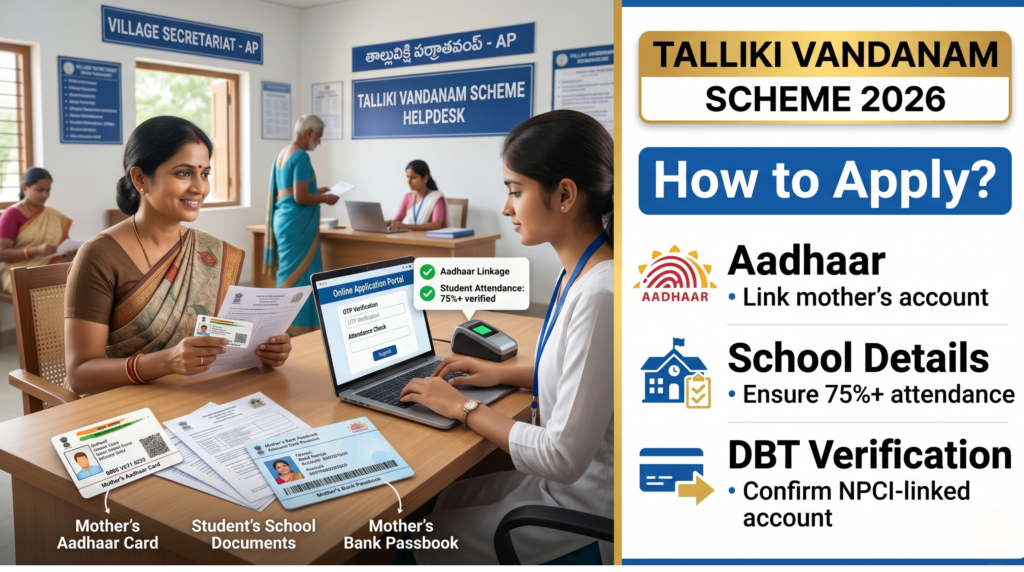
- Aadhaar Card of Mother/Guardian
- Student Aadhaar Details
- Bank Passbook
- Mobile Number
- Student School Records
- Residence Proof
- Ration Card (where applicable)
Keeping records updated can significantly reduce verification issues.
How Beneficiary Verification Works
One of the most important parts of the scheme is beneficiary verification.
Step 1: Student Verification
School records are checked to confirm enrollment.
Step 2: Aadhaar Authentication
Student and guardian details are matched with Aadhaar databases.
Step 3: Family Verification
Family information is validated through government databases.
Step 4: Bank Account Validation
Authorities verify that the beneficiary account can receive DBT payments.
Step 5: Final Approval
Only verified beneficiaries are included in the payment list.
What To Do If Your Name Is Missing from the Beneficiary List?
If an eligible student is not included in the beneficiary list, parents should:
- Verify student records with the school
- Check Aadhaar details of the student and mother/guardian
- Confirm bank account information
- Ensure mobile number details are updated
- Contact the concerned authorities for verification
Many beneficiary issues are resolved after correcting record mismatches or verification errors.
Common Verification Mistakes
Some of the most common reasons for verification failure include:
- Incorrect Aadhaar number
- Student name mismatch in school records
- Wrong bank account details
- Inactive mobile number
- Duplicate beneficiary entries
Checking these details before verification can help avoid delays in receiving benefits.
Common Reasons Why Benefits Are Delayed
Many payment issues occur because of avoidable mistakes.
Aadhaar Mismatch
Differences in beneficiary records can stop payments.
Incorrect Bank Account Details
Inactive or invalid accounts may reject DBT transfers.
Pending Verification
Applications under review may not receive immediate approval.
School Record Errors
Incorrect student details can delay processing.
Mobile Number Issues
Unlinked or outdated mobile numbers can affect verification.
How to Check Talliki Vandanam Status
Before checking eligibility or payment status, keep the following details available:
- Aadhaar Number
- Registered Mobile Number
- Student Information
- Beneficiary Details
Parents should use official government portals and local secretariat services whenever verification assistance is required.
Beneficiary Checklist
Before every payment cycle, verify:
✓ Aadhaar linked correctly
✓ Active bank account
✓ Correct student records
✓ Updated mobile number
✓ Completed verification requirements
✓ Accurate family details
These simple checks help prevent payment delays.
➤ Read More: Digital Lakshmi Scheme 2026: Digital Entrepreneurship Support for Women
When Are Talliki Vandanam Benefits Usually Released?
Benefit release schedules depend on government approvals, beneficiary verification, and academic-year implementation timelines.
Before funds are credited:
- Student records are verified
- Beneficiary details are validated
- Aadhaar authentication is completed
- Bank accounts are checked for DBT eligibility
Beneficiaries should regularly monitor official announcements for payment-related updates.
Impact of the Scheme
According to publicly available government data, more than 67 lakh students have been identified under the scheme framework. For families with multiple school-going children, educational expenses can place significant pressure on household finances. The assistance provided through Talliki Vandanam helps reduce this burden and supports continued access to education.
Key outcomes include:
- Reduced financial burden on families
- Increased educational support
- Assistance for multiple children within a family
- Direct transfer of benefits through DBT
- Improved access to school education
Government reports indicate that more than 67 lakh students are covered under the scheme framework.
➤ Check Also: Nirudhyoga Bruthi Scheme 2026: Eligibility, Benefits, Documents & Latest Updates
Important Official Resources
| Action | Link |
|---|---|
| Andhra Pradesh Government Portal | Visit Website |
| Aadhaar Services | Open UIDAI Portal |
| DBT Bharat Portal | Check DBT Information |
| National Government Services | Visit Portal |
| PM-KISAN Official Portal | Open Portal |
Frequently Asked Questions
How much money is credited under Talliki Vandanam?
Eligible beneficiaries generally receive ₹13,000 directly in their bank account, while ₹2,000 is allocated for school development purposes.
Is the benefit available for every child?
Yes. The scheme framework covers every eligible school-going child in a family rather than limiting benefits to a single child.
Why was my payment delayed?
Common reasons include Aadhaar mismatch, incorrect bank details, incomplete verification, or student record discrepancies.
Is Aadhaar mandatory?
Aadhaar-based verification is generally used for beneficiary identification and DBT processing.
Can beneficiary details be corrected?
Yes. Beneficiaries should contact the relevant authorities if corrections are required.
Conclusion
Talliki Vandanam represents a major educational support initiative aimed at helping families manage the cost of schooling. While many parents focus only on the ₹13,000 benefit, successful payment depends on accurate Aadhaar information, valid bank accounts, updated student records, and successful beneficiary verification. Families who keep their records updated are more likely to receive assistance without delays.

Venkatesh is the Content Lead and Researcher at UNQ Information. He researches government schemes, pension programs, citizen services, and welfare initiatives related to Andhra Pradesh and Telangana. He regularly publishes updates and educational content to help readers understand eligibility criteria, required documents, application procedures, benefit details, and important government announcements in a simple and easy-to-understand format.