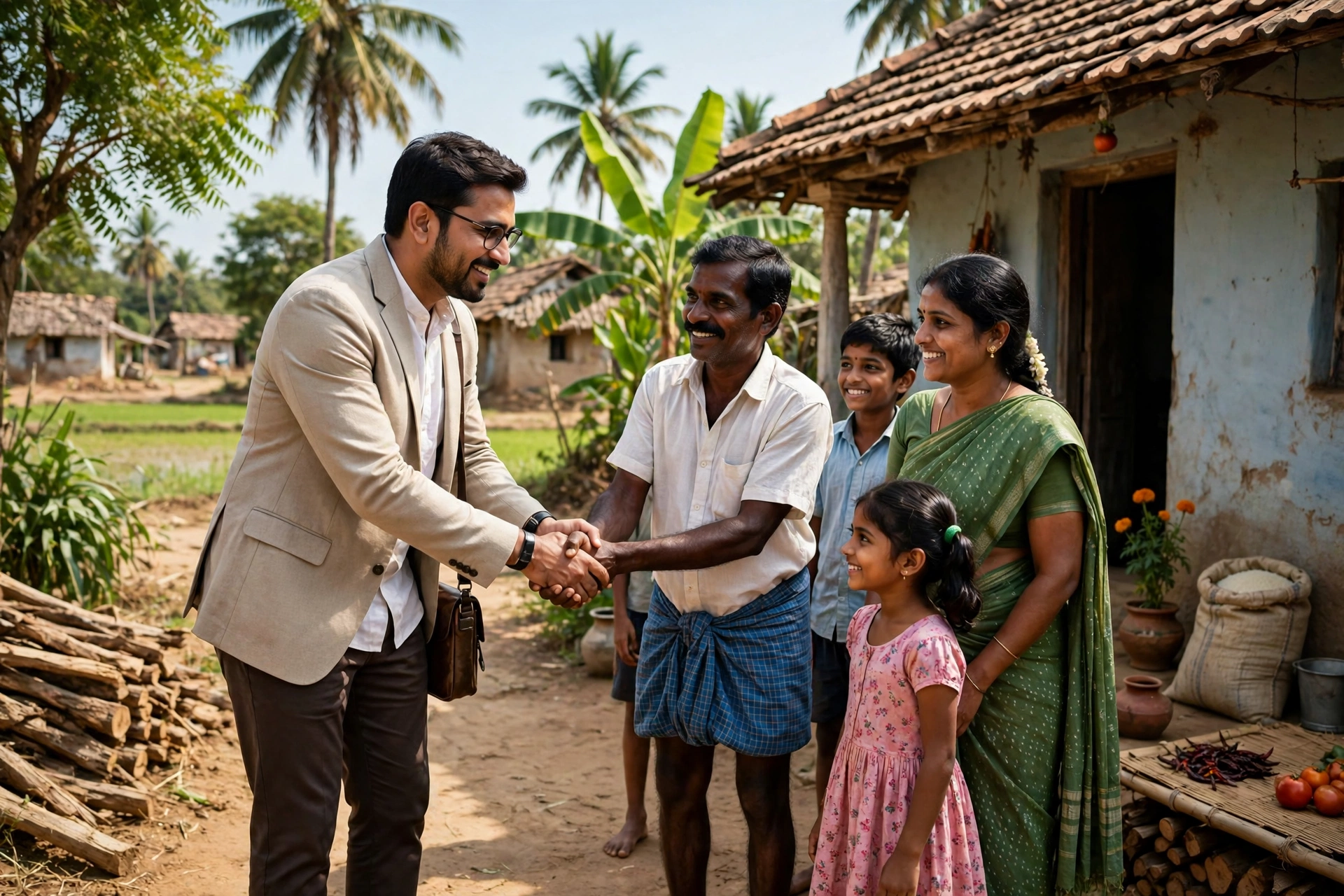

Andhra Pradesh is trying a different way to end poverty. Instead of the government giving money directly, the P4 Bangaru Kutumbam programme asks well-off people to adopt and mentor poor families — and help them stand on their own feet. The government only connects the two sides; it does not pay anything through P4.
This guide explains P4 Bangaru Kutumbam in plain words: what the programme is, who a Margadarsi and a Bangaru Kutumbam are, what support a family gets, how families are chosen, how you can join as a mentor, and how far the programme has reached.
What is the P4 Bangaru Kutumbam programme?
P4 stands for Public-Private-People Partnership. It is the Andhra Pradesh government’s flagship poverty-eradication programme, launched by Chief Minister N. Chandrababu Naidu on 30 March 2025, on Ugadi (Telugu New Year), in Amaravati, along with Deputy Chief Minister Pawan Kalyan.
P4 is the first action item of the 10-point plan under the Swarna Andhra Vision 2047, which aims to make Andhra Pradesh a $2.4 trillion economy by 2047. The stated goal of P4 is zero poverty: reports at the launch put 2029 as the target year for a poverty-free state, and the government says it hopes this model will lift around 15 lakh households out of poverty by 2029. The programme sits inside the longer Swarna Andhra Vision 2047.
The idea is simple. The richest 10 percent of the population are asked to handhold the poorest 20 percent. The mentor gives guidance, contacts, skills and money for specific needs; the family uses that help to build a steady income. The government frames the policy, identifies the poor families, runs the platform, and checks that the promised help actually reaches the family.
Margadarsi and Bangaru Kutumbam: who is who?
There are only two roles in P4.
Margadarsi (mentor or guide). A Margadarsi is a well-off individual, family, company, institution or member of the Telugu diaspora who volunteers to support a poor family. Margadarsis are not just donors. They are expected to guide the family — help with children’s education, health care, skills, a small business, or a job — and stay in touch until the family can manage on its own. Companies can join as Margadarsis too: in July 2026, the Adani Foundation joined as a Margadarsi for Kuppam mandal in Chittoor district, covering all 29 gram panchayats there.
Bangaru Kutumbam (golden family). A Bangaru Kutumbam is an economically weaker family identified by the government as needing help. The name means “golden family” — the idea is that every poor family has value and can rise with the right support. These families keep getting the benefits of existing government welfare schemes as well; P4 support comes on top of them, not instead of them.
What support does a Bangaru Kutumbam get?
P4 does not give every family the same fixed amount. Support is customised: the mentor and the family decide together what the family needs most. According to the official tender document of the Swarna Andhra P4 Foundation, the help covers four areas — education, health, livelihood and social security. In practice, that includes:
- Education: school fees, tuition, books, and guidance for children, including help to join skill training or higher education.
- Health: help with medical treatment and health costs. For cashless hospital treatment, families can also use Dr. NTR Vaidya Seva, which gives up to ₹25 lakh cashless treatment.
- Livelihood: help to start or grow a small business — tools, machines or working capital. In Kuppam, the Chief Minister handed over sewing machines, welding kits and embroidery machines to Bangaru Kutumbams. A family starting a small unit can also look at MSME schemes in AP for loans and subsidies.
- Housing and basic facilities: house sites and help with house construction, sanitation, 100% tap water, LPG connection, rooftop solar incentives, and high-speed internet. See the Jal Jeevan Mission guide for tap water, PM Surya Ghar in AP for rooftop solar, and PM Ujjwala Yojana in AP for LPG connections.
- Guidance and linkages: career mentorship, financial literacy, and help in connecting the family to existing government welfare schemes it may have missed.
The help is personal: mentor and family agree on a plan — a sewing machine plus training for the mother, school support for the children, a health check-up for an elder — and the government tracks whether it is carried out.
How are Bangaru Kutumbam families chosen?
A poor family cannot apply for P4 on its own. Families are identified by the government, in three steps:
- Survey and data. Village and ward secretariat staff surveyed the state and listed about 21.8 lakh families below the poverty line. Government data analysis then picked the most deprived families for priority. The first phase covers 20 lakh families.
- Needs assessment. A survey records what each family actually needs — education, health, livelihood, housing, water, or something else — so the help can be matched to the family.
- Gram Sabha and Ward Sabha. The final list is fixed transparently through Gram Sabhas (in villages) and Ward Sabhas (in towns), so that disputes can be avoided. The Chief Minister was clear at the launch that selection must be transparent and that no one should be forced to join, either as a mentor or as a beneficiary.
If your family is poor and not on the list, the place to raise it is your Gram Sabha or your village/ward secretariat — they did the survey and the list is settled there.
How to join P4: for mentors and for families
If you want to become a Margadarsi:
- Go to the official P4 portal at p4.ap.gov.in (also a mobile app). Sign up and look at the families in need — all listed families belong to the bottom 20% in the state.
- Choose one of three ways to help: Adopt a Family, Adopt a Village or Community, or Fund a Need.
- Select the family, village or need you want to support, and agree with the family on what help you will give. The platform records the commitment, and the government reviews from time to time whether the promised help was given.
Anyone can volunteer — individuals, families, companies, institutions and NRIs. The Chief Minister has said clearly that no one will be forced to contribute.
If you are a poor family:
There is no form to fill and no office to apply to. Your family must be on the government list, made through the survey and the Gram Sabha. If you are on it, a Margadarsi can adopt your family and plan the help with you. If not, raise it at your Gram Sabha or village/ward secretariat. No one can charge you money to put your name on the P4 list, and P4 gives no direct cash payment.
How far has P4 reached?
The programme has grown fast in its first year:
- At the start (June 2025): 19,15,771 families were registered as Bangaru Kutumbalu in the state, and Margadarsis had adopted 70,272 of them.
- After nine months (January 2026): 10.42 lakh families had been mapped to 1.03 lakh benefactors, and officials hoped to map the remaining 10.5 lakh families in the next six to nine months.
- After one year (30 March 2026): 1.06 lakh Margadarsis had come forward to adopt 10.3 lakh families.
- August 2026: the Chief Secretary said 10 lakh Bangaru Kutumbams had been adopted, with a target of linking 15 lakh families with Margadarsis by 15 August 2026.
For scale: NITI Aayog counts about 6.06 percent of Andhra Pradesh’s 5.3 crore people as poor. The state government set up the Zero Poverty P4 Foundation as the nodal agency, and the Smart Andhra Pradesh Foundation was restructured as the Swarna Andhra P4 Foundation (G.O.Rt.No.107, Planning Department, 25 June 2025) to run the programme and bring in CSR funds and donor contributions.
What P4 is not
Three things about P4 are often misunderstood:
- It is not a government cash scheme. The state gives no money through P4 and handles no financial transactions. The money and help come from the Margadarsi, and the government only connects the two sides and monitors the work.
- It is not a replacement for welfare schemes. P4 is separate from existing welfare programmes. A Bangaru Kutumbam keeps its ration card, pension, scholarships and other scheme benefits.
- It is not compulsory. Joining as a Margadarsi is voluntary, and adoption of a family is voluntary. The Chief Secretary has said plainly that no one should be forced into it.
Frequently asked questions
Who can become a Margadarsi?
Any well-off individual, family, company, institution or NRI who wants to volunteer. Sign up on the official P4 portal, choose Adopt a Family, Adopt a Village or Community, or Fund a Need, and select whom to support. Registration is free.
How does a poor family become a Bangaru Kutumbam?
The family does not apply. The government identifies poor families through data and surveys, and the final list is fixed in Gram Sabhas and Ward Sabhas. The first phase gives priority to the 20 lakh most deprived families.
Does a Bangaru Kutumbam get monthly money from the government under P4?
No. P4 gives no direct cash payment from the government. Support comes from the Margadarsi — education, health care, livelihood help, housing or other agreed needs — and the government only facilitates and monitors it.
Is P4 the same as Talliki Vandanam or other welfare schemes?
No. P4 is separate from welfare schemes. A family can receive P4 support and still get its normal benefits, such as ration, pension or scholarships.
How do I know P4 is genuine and not a fraud?
Use only the official P4 portal (p4.ap.gov.in) and the Swarna Andhra P4 Foundation website. No genuine P4 worker will ask your family for money to add your name to a list. If someone asks for money in the name of P4, report it to your village/ward secretariat.
P4 is an experiment: can the well-off of Andhra Pradesh lift the poorest families out of poverty, family by family, instead of waiting for the government to do it alone? In its first year, more than 10 lakh families found a mentor. Whether it reaches zero poverty by 2029 depends on whether those mentors stay until the help turns into a steady income. For a poor family, the first step is simple — check whether your name is on the P4 Bangaru Kutumbam list at your Gram Sabha.

Venkatesh is the Content Lead and Researcher at UNQ Information. He researches government schemes, pension programs, citizen services, and welfare initiatives related to Andhra Pradesh and Telangana. He regularly publishes updates and educational content to help readers understand eligibility criteria, required documents, application procedures, benefit details, and important government announcements in a simple and easy-to-understand format.