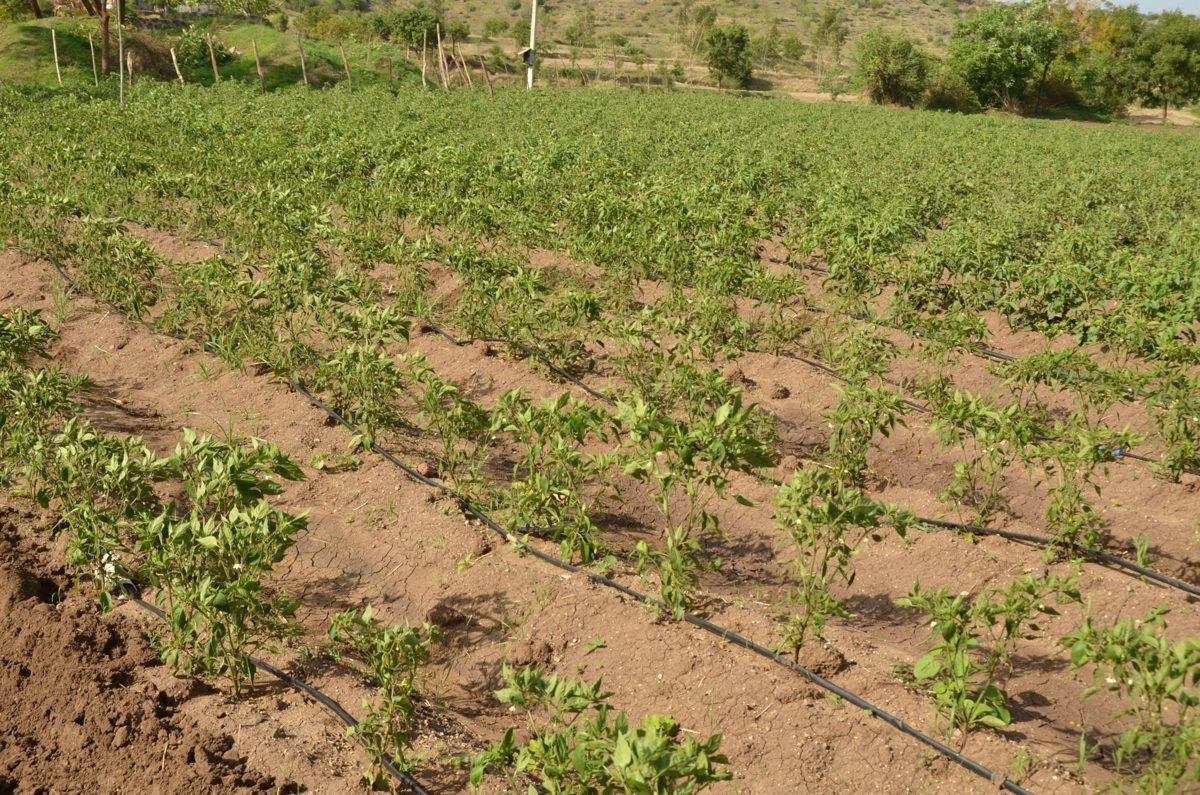

For a farmer growing banana, mango, papaya or vegetables in Andhra Pradesh, water is the biggest cost after seed and fertiliser. Flood irrigation wastes it, and in Rayalaseema and Prakasam it is scarce. So the state’s main horticulture support is a subsidy on drip and sprinkler systems: the government pays most of the cost.
The scheme is the Andhra Pradesh Micro Irrigation Project (APMIP), run under the Centre’s Per Drop More Crop programme and topped up by the state. The Mission for Integrated Development of Horticulture (MIDH) pays half the cost of polyhouses and shade nets, and crop insurance and income support cover the crop itself. These horticulture schemes in AP cover drip and sprinkler systems, polyhouses, crop insurance and income support.
At a glance
| Item | Detail |
|---|---|
| Main scheme | Andhra Pradesh Micro Irrigation Project (APMIP), under Per Drop More Crop (PDMC) |
| Who can apply | All AP farmers, incl. tenants with valid lease documents |
| Drip, small/marginal farmers (up to 5 acres) | 90%; SC/ST small/marginal farmers 100% |
| Drip, medium farmers (above 5 to 10 acres) | 70% coastal; 90% Rayalaseema, Prakasam, ST farmers in ITDA areas |
| Drip, big farmers | 50% |
| Sprinkler, small/marginal farmers (up to 5 acres) | 50% |
| Central PDMC rates | 55% small/marginal, 45% others; max 5 hectares per farmer |
| Polyhouse / shade net (MIDH) | 50% of eligible cost; farmer pays the other 50% |
| Where to apply | Village MeeSeva centre or District MIP office; apmip.ap.gov.in |
| Documents | Land document, Aadhaar card, live bank account proof |
Horticulture schemes in AP: what APMIP pays for drip irrigation
APMIP installs micro irrigation systems — drip, portable sprinkler, semi-permanent sprinkler, mini sprinkler, micro sprinkler and rain guns — in five sectors: horticulture, agriculture, oil palm, sugarcane and sericulture.
The pattern is fixed by government order (G.O.Ms.No.493, 2 August 2022; current pattern G.O.Rt.No.82 of 17 February 2025). The drip rates are:
- SC/ST small/marginal farmers (up to 5 acres): 100% — the government pays the full cost.
- Other small/marginal farmers (up to 5 acres): 90%, up to ₹2,00,000.
- Medium farmers (5–10 acres) in Rayalaseema/Prakasam, and ST farmers in ITDA areas: 90%, up to ₹2,80,000.
- Medium farmers (5–10 acres) in coastal districts except Prakasam: 70%, up to ₹2,80,000.
- Big farmers: 50%, up to ₹4,00,000.
Sprinklers: small/marginal farmers (up to 5 acres) get 50%. Forest Rights Act patta holders in tribal areas get 100% under the Dharti Aaba Janjatiya Gram Utkarsh Abhiyan (G.O.Rt.No.206 of 18 March 2026).
The state tops up the central assistance from its own budget — that is how a small farmer in AP gets 90% instead of 55%. And the farmer chooses the supplier: the Horticulture Department’s FAQ says the farmer is free to select the supplier of his or her choice. Our guide to the AP Micro Irrigation Project explains the project, and our farm subsidies in AP guide lists the other subsidies a farmer can claim alongside it.
The central scheme behind it: Per Drop More Crop
APMIP is the state arm of Per Drop More Crop (PDMC), the micro irrigation part of the Pradhan Mantri Krishi Sinchayee Yojana (PMKSY), launched on 1 July 2015. PDMC was part of PMKSY from 2015-16 to 2021-22, and from 2022-23 it runs under the Rashtriya Krishi Vikas Yojana (PM-RKVY).
Under the central pattern, small and marginal farmers get 55% assistance and other farmers 45%, shared 60:40 between Centre and state, limited to 5 hectares per beneficiary. States then add their own top-up.
So far, 110.92 lakh hectares have come under micro irrigation across India. Andhra Pradesh is the top-performing state: the state government says 1.26 lakh hectares are covered and ₹1,030 crore in subsidies given under APMIP.
The state is now pushing automated drip: Agriculture Minister K. Atchannaidu has said the aim is to convert every drop of water into income, with assistance of up to ₹40,000 per hectare. Automation can also be fitted to an existing drip system.
Which crops and systems drip works for
Drip is not one fixed kit. For large spacing — orchards and oil palm — APMIP uses the “online” method: gravity-fed family systems, micro jets, micro sprinklers, drippers or emitters, and mini sprinklers. For small spacing — vegetables and flowers — it uses the “in line” method, with surface or sub-surface laterals.
The department lists these crops as suitable for drip: banana, papaya, mango, turmeric, sweet orange, acid lime, betelvine, pomegranate, melons, onion, flowers and vegetables — most of the horticulture grown in the state.
Water can come from an open well, a borewell, a tank or a canal. What matters is cultivable land and an assured water source. A drip system has five parts: control valves, a fertiliser or venturi tank, a sand or screen filter, the mainline, sub-main and lateral pipes, and the drippers at the plant root. The fertiliser tank lets you feed the crop through the same pipes that water it.
Polyhouse and shade net support under MIDH
Drip waters the crop. A polyhouse or shade net protects it. That support comes from the Mission for Integrated Development of Horticulture (MIDH), which funds protected cultivation across the country.
Under MIDH, the subsidy for polyhouses, greenhouses and shade net houses is 50% of the maximum eligible cost; the farmer pays the other 50%. The cost norms (Parliament answer, March 2026) are: fan-and-pad polyhouse ₹1,800 per sq.m. up to 500 sq.m. and ₹1,600 above 500 sq.m. up to 1,008 sq.m.; bamboo/cable purlin polyhouse ₹450 per sq.m.; shade net house (tubular/rectangular) ₹710 per sq.m.; bamboo/cable purlin shade net ₹450 per sq.m. The AP Horticulture Department’s MIDH guidelines for 2025 confirm the same 50% in the state.
A polyhouse suits capsicum, cucumber, tomato and flowers; a shade net suits nurseries, leafy vegetables and floriculture. Both allow off-season growing, when prices are higher. Apply through the District Horticulture Office, and confirm the cost norm and structure type before you pay a vendor.
Crop support beyond irrigation
Irrigation and a polyhouse protect the crop, but they do not pay for a failed season. Three other schemes cover that side, and a horticulture farmer should use them together with APMIP.
Crop insurance. The Pradhan Mantri Fasal Bima Yojana (PMFBY) covers notified horticulture crops as well as food crops. If a notified crop is lost to drought, flood, cyclone or pest attack, the insurance pays. Our guide to PM Fasal Bima in AP explains which crops are notified and how to enrol.
Income support. Annadata Sukhibhava pays ₹20,000 per farmer family per year in three instalments, and covers horticulture farmers the same as paddy farmers. The first instalment for 2026-27 was released on 20 June 2026. Keep your e-panta booking updated — benefits are tied to the crop record. Our guide explains why Annadata Sukhibhava needs e-panta and how to complete it.
Free power. Free power to agriculture matters because the pump runs the system. A drip set uses far less power than flood irrigation for the same field, so the subsidy cuts the cost of the pipes and free power cuts the cost of running them.
How to apply for APMIP
There is no single online form. Apply at a village MeeSeva centre or the District Micro Irrigation Project Director’s office with three things: your land document, your Aadhaar card, and proof of a live bank account. Lease farmers can apply with valid lease documents. The portal is apmip.ap.gov.in.
After you apply, the field is inspected and the design is fixed for your crop spacing; you select the supplier of your choice; the system is installed and inspected again; then the subsidy is released. Prices are fixed for empanelled companies — if anyone asks for extra money beyond the fixed price, report it to the District Micro Irrigation office.
APMIP and the supplier also train the farmer — crop rotation, irrigation scheduling, intercropping, fertiliser dose, and pest control. A polyhouse needs a separate application at the District Horticulture Office under MIDH; the two subsidies do not cancel each other.
What to do now
- Check your category. Up to 5 acres means 90% on drip, 100% if you are SC/ST. Above 5 to 10 acres: 90% in Rayalaseema and Prakasam, 70% in other coastal districts.
- Confirm your water source. Open well, borewell, tank or canal all qualify. Keep the proof ready with your land document.
- Apply at MeeSeva or the District MIP office with land document, Aadhaar and live bank account proof. Keep the acknowledgement.
- Choose your own supplier. Pick any empanelled supplier, and compare the design for your crop spacing before you agree.
- Book your crop in e-panta. Your crop record links you to Annadata Sukhibhava and crop insurance. Our Rabi season checklist for AP farmers covers what is due this month.
- Do not pay anyone extra. The pattern and prices are fixed; no middleman can increase your subsidy.
Frequently asked questions
Who can get the drip subsidy in AP?
These horticulture schemes in AP are open to all AP farmers, the Horticulture Department says. Small and marginal farmers get the highest rates, but medium and big farmers also get subsidy, and tenants with valid lease documents can apply.
How much subsidy will I get for drip?
Up to 5 acres: 90%, or 100% for SC/ST small and marginal farmers. Above 5 to 10 acres: 70% or 90% depending on the district. Big farmers: 50%. The central PDMC rate is 55%/45% — the state top-up takes AP farmers higher.
Where do I apply for APMIP?
At your village MeeSeva centre or the District MIP office, with land document, Aadhaar and live bank account proof. The portal is apmip.ap.gov.in.
Does the subsidy cover polyhouses too?
No — polyhouses and shade nets are covered by MIDH, not APMIP. MIDH pays 50% of the eligible cost; apply at the District Horticulture Office. You can claim both.
Is there a last date to apply?
APMIP runs through the year, but funds follow annual targets — Tirupati district had a 2025-26 target of 4,000 hectares. Apply early so installation is inspected before the crop needs water.
Sources
- AP Horticulture Department, APMIP FAQ — systems, eligibility, how to apply, supplier choice: https://horticulturedept.ap.gov.in/Horticulture/New_MIP_FAQ.aspx
- Tirupati District, Govt of AP, APMIP — sectors, crops, subsidy pattern (G.O.Ms.No.493, 02.08.2022), 2025-26 target: https://tirupati.ap.gov.in/andhra-pradesh-micro-irrigation-project-apmip/
- PIB, “PMKSY — A Decade of Irrigation”, 30 June 2026 — PDMC 55%/45%, 110.92 lakh hectares, 27 million farmers: https://www.pib.gov.in/PressReleasePage.aspx?PRID=2279431®=3&lang=1
- Lok Sabha Question No. 2838, 10 March 2026, Protected Cultivation — MIDH 50% subsidy, cost norms: https://sansad.in/getFile/loksabhaquestions/annex/187/AU2838_QQhErP.pdf?source=pqals

Venkatesh is the Content Lead and Researcher at UNQ Information. He researches government schemes, pension programs, citizen services, and welfare initiatives related to Andhra Pradesh and Telangana. He regularly publishes updates and educational content to help readers understand eligibility criteria, required documents, application procedures, benefit details, and important government announcements in a simple and easy-to-understand format.