
Children who lose parental care or grow up in vulnerable family situations often face significant challenges in accessing education, healthcare, nutrition, and emotional support. Financial difficulties can increase the risk of school dropout, child labour, neglect, or social exclusion AP Mission Vatsalya Scheme 2026 .
To strengthen child protection and ensure that children continue their education in a safe environment, the Government of India implements Mission Vatsalya through state-level child welfare systems. The program focuses on supporting orphaned, abandoned, surrendered, and vulnerable children through various child protection services, sponsorship assistance, rehabilitation measures, and family-based care mechanisms.
Many caregivers are unsure about who qualifies for sponsorship assistance, how eligibility is assessed, what documents are required, and how approval decisions are made. Understanding these procedures can help eligible children receive support more efficiently and reduce delays during verification.
Quick Scheme Overview
| Particulars | Details |
|---|---|
| Scheme Name | Mission Vatsalya |
| Implementing Authority | Ministry of Women and Child Development |
| State Implementation | Andhra Pradesh Child Welfare System |
| Benefit Type | Child Protection and Sponsorship Support |
| Target Beneficiaries | Orphan, Vulnerable, Abandoned and Children in Need of Care and Protection |
| Objective | Education, Protection, Rehabilitation and Family-Based Care |
| Assistance Mode | Sponsorship and Child Welfare Support |
| Verification | Child Welfare Committees and District Authorities |
What Is Mission Vatsalya?
Mission Vatsalya is a child protection initiative aimed at creating a safe and supportive environment for children who require care and protection. The program focuses on strengthening family-based care while reducing the need for institutionalization whenever possible.
The scheme supports children facing difficult circumstances, including:
- Orphaned children
- Children with single parents facing financial hardship
- Children in vulnerable families
- Abandoned children
- Children requiring rehabilitation and protection
- Children identified by welfare authorities as needing support
The overall goal is to ensure that every child receives opportunities for education, development, protection, and social inclusion.
➤ Related Guide: Adabidda Nidhi Scheme 2025: Eligibility, Benefits, Documents & Latest Updates
Why Was Mission Vatsalya Introduced?
Children from vulnerable households often face multiple risks simultaneously.
Common challenges include:
- Educational interruptions
- Financial instability
- Lack of family support
- Poor access to healthcare
- Child labour risks
- Social exclusion
- Nutritional deficiencies
Mission Vatsalya aims to reduce these risks by strengthening child protection mechanisms and supporting children within family and community environments wherever possible.
Sponsorship Assistance Explained
One of the most important components of Mission Vatsalya is sponsorship support.
Financial assistance may be provided for children identified as needing care and protection so that education and essential needs can continue without interruption.
The objective is to strengthen family-based care rather than separate children from their communities whenever avoidable.
Actual assistance amounts and eligibility are determined according to government guidelines and child welfare assessments.
Who Can Receive Support?
Potential beneficiaries may include:
- Orphan Children
- Semi-Orphan Children
- Children from Extremely Vulnerable Families
- Children Living with Single Parents Facing Severe Financial Hardship
- Children in Need of Care and Protection
- Children Identified by Child Welfare Committees
Eligibility is assessed individually through official verification processes.
Who Is Not Eligible?
Support may not be approved if:
- Required verification cannot be completed
- Documents are incomplete
- Child protection authorities determine that eligibility conditions are not met
- Duplicate applications exist
- False information is submitted
Every application is reviewed according to child welfare guidelines.
➤ Read More: Digital Lakshmi Scheme 2026: Digital Entrepreneurship Support for Women
How Sponsorship Assistance Supports Children
Financial support provided under child welfare programs can help families meet important educational and developmental needs.
Common areas where support may be utilized include:
- School-related expenses
- Educational materials
- Nutrition requirements
- Healthcare needs
- Transportation costs
- Child development activities
The objective is to create a stable environment that allows children to continue their education and overall development without unnecessary interruptions.
Common Verification Mistakes
Applications are sometimes delayed because of avoidable issues.
Common examples include:
- Incorrect Aadhaar information
- Missing supporting documents
- Inconsistent school records
- Outdated guardian information
- Incorrect bank account details
- Incomplete application forms
Applicants should carefully review all information before submission.
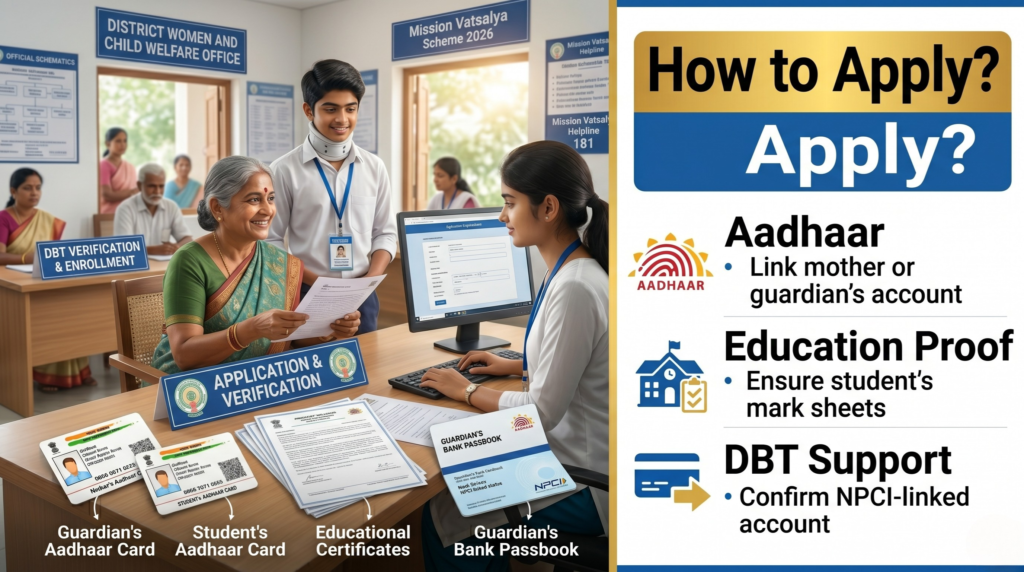
Documents Required
Applicants may need:
- Child Aadhaar Card
- Guardian Aadhaar Card
- Birth Certificate
- School Certificate
- Residence Proof
- Income Certificate
- Death Certificate of Parents (where applicable)
- Bank Account Details
- Passport Size Photographs
Additional documents may be requested during verification.
How Child Verification Works
Mission Vatsalya applications typically undergo multiple verification stages.
Step 1: Child Identification
The child is identified through local authorities, welfare systems, educational institutions, or guardians.
Step 2: Document Verification
Supporting documents are reviewed.
Step 3: Family Assessment
Authorities evaluate family circumstances and vulnerability factors.
Step 4: Child Welfare Review
Child Welfare Committees assess eligibility according to prescribed guidelines.
Step 5: Approval Process
Eligible cases are recommended for support and sponsorship assistance.
Common Reasons Why Applications Are Delayed
Applications may face delays because of:
- Missing documents
- Incomplete verification
- Incorrect personal information
- School record discrepancies
- Pending welfare assessments
- Unverified guardian details
Submitting accurate information helps reduce processing delays.
➤ Check Also: Nirudhyoga Bruthi Scheme 2026: Eligibility, Benefits, Documents & Latest Updates
What To Do If Support Is Not Approved?
Applicants should:
- Review document requirements
- Verify child and guardian information
- Confirm school records
- Contact local child welfare authorities
- Seek clarification regarding eligibility findings
Many issues can be resolved after correcting documentation errors.
Renewal and Continued Verification
Mission Vatsalya support may require periodic review.
Authorities may periodically verify:
- School attendance
- Child welfare status
- Family circumstances
- Eligibility conditions
- Beneficiary records
Keeping records updated can help ensure uninterrupted support.
Beneficiary Checklist
Before submitting an application:
✓ Aadhaar details are correct
✓ School records are updated
✓ Required certificates are available
✓ Guardian information is accurate
✓ Bank account details are valid
✓ Contact information is active
✓ Supporting documents are complete
Impact of the Scheme
For vulnerable children, financial support alone is often not enough. Access to education, healthcare, nutrition, and a stable family environment plays an equally important role in long-term development. Mission Vatsalya focuses on creating a protective support system around children while helping families continue care within their communities whenever possible.
By supporting education and child welfare needs, the program aims to reduce risks such as school dropout, neglect, social exclusion, and child labour among vulnerable children.
Potential benefits include:
- Improved educational continuity
- Better access to welfare services
- Reduced financial pressure on vulnerable families
- Enhanced child protection mechanisms
- Support for family-based care
- Better long-term developmental outcomes
The program focuses not only on financial assistance but also on creating a supportive environment that promotes the overall well-being of children.
➤ Read Also: NTR Baby Kit Scheme 2025: Free Baby Care Kit Benefits, Eligibility & Distribution Details
Important Official Resources
| Action | Link |
|---|---|
| Women & Child Development Ministry | Visit Website |
| Mission Vatsalya Portal | Open Portal |
| Andhra Pradesh Government | Visit Portal |
| National Child Helpline | Get Help |
| Government of India Portal | Visit Website |
Frequently Asked Questions
1.What is Mission Vatsalya?
Mission Vatsalya is a child protection program that supports children in need of care and protection through various welfare and rehabilitation mechanisms.
2.Who can receive support?
Orphaned, vulnerable, abandoned, and eligible children identified through child welfare mechanisms may receive support.
3.Is financial assistance available?
Sponsorship assistance may be provided in eligible cases according to government guidelines and welfare assessments.
4.Are school-going children eligible?
Educational continuity is one of the key objectives of the program, subject to eligibility verification.
5.How is eligibility verified?
Verification generally involves document review, family assessment, and Child Welfare Committee evaluation.
Conclusion
Mission Vatsalya is designed to strengthen child protection systems while supporting vulnerable children through education, welfare services, family-based care, and sponsorship assistance. Successful approval depends on proper documentation, eligibility verification, and child welfare assessment. Families and guardians who maintain accurate records and cooperate with verification procedures are more likely to receive timely support for eligible children.
Venkatesh is the Content Lead and Researcher at UNQ Information. He researches government schemes, pension programs, citizen services, and welfare initiatives related to Andhra Pradesh and Telangana. He regularly publishes updates and educational content to help readers understand eligibility criteria, required documents, application procedures, benefit details, and important government announcements in a simple and easy-to-understand format.