
PM KUSUM in AP: Solar Pumps for Farmers, Subsidy & How to Apply
For many AP farmers, irrigation depends on diesel and the timing of grid power. Diesel is expensive, and a grid pump only runs when power is supplied. PM KUSUM in AP helps farmers run their pumps on sunlight instead.
PM-KUSUM — Pradhan Mantri Kisan Urja Suraksha evam Utthaan Mahabhiyan — is run by the Ministry of New and Renewable Energy (MNRE), launched in March 2019 for farmers’ energy and water security and to cut diesel use.
This guide explains each part, the subsidy, who can apply, and how to apply in AP. Note: PM KUSUM is not PM Surya Ghar, which subsidises rooftop solar on houses; PM KUSUM is for farms.
What is PM KUSUM?
PM KUSUM is a central scheme implemented through the states. In AP, NREDCAP — the New and Renewable Energy Development Corporation of Andhra Pradesh, the state nodal agency — handles it with the DISCOMs (APSPDCL, APEPDCL, APCPDCL) and the Agriculture Department.
The scheme is demand-driven: MNRE allocates capacity on state demand and milestones achieved, and the State Implementing Agency selects beneficiaries. A farmer in AP applies through the AP channel NREDCAP or the DISCOM notifies — not directly to MNRE in Delhi.
MNRE’s overall target is 34.8 GW of solar capacity, with a total outlay of ₹34,422 crore. By 31 December 2025, 9,75,227 standalone pumps (Component B) and 12,01,552 solarised pumps (Component C) were in place across India, plus 720.91 MW under Component A — 21,77,369 farmers in all (Rajya Sabha reply, March 2026).
The three components of PM KUSUM
PM KUSUM has three components; most AP farmers will only deal with B or C.
Component A: small solar plants on barren land
Under Component A, grid-connected solar plants of 500 kW to 2 MW can be set up on barren, fallow or uncultivable land. The farmer earns by selling power to the DISCOM under a power purchase agreement, or by leasing the land to a developer. There is no central assistance; the DISCOM instead gets 40 paise per unit or ₹6.60 lakh per MW per year, whichever is lower, for five years. In AP, the Cabinet approved in August 2026 leasing Kadapa-district land to NREDCAP for PM-KUSUM projects — 49.67 acres at Cherlopalli and 51.37 acres at Vemula.
Component B: standalone solar pumps
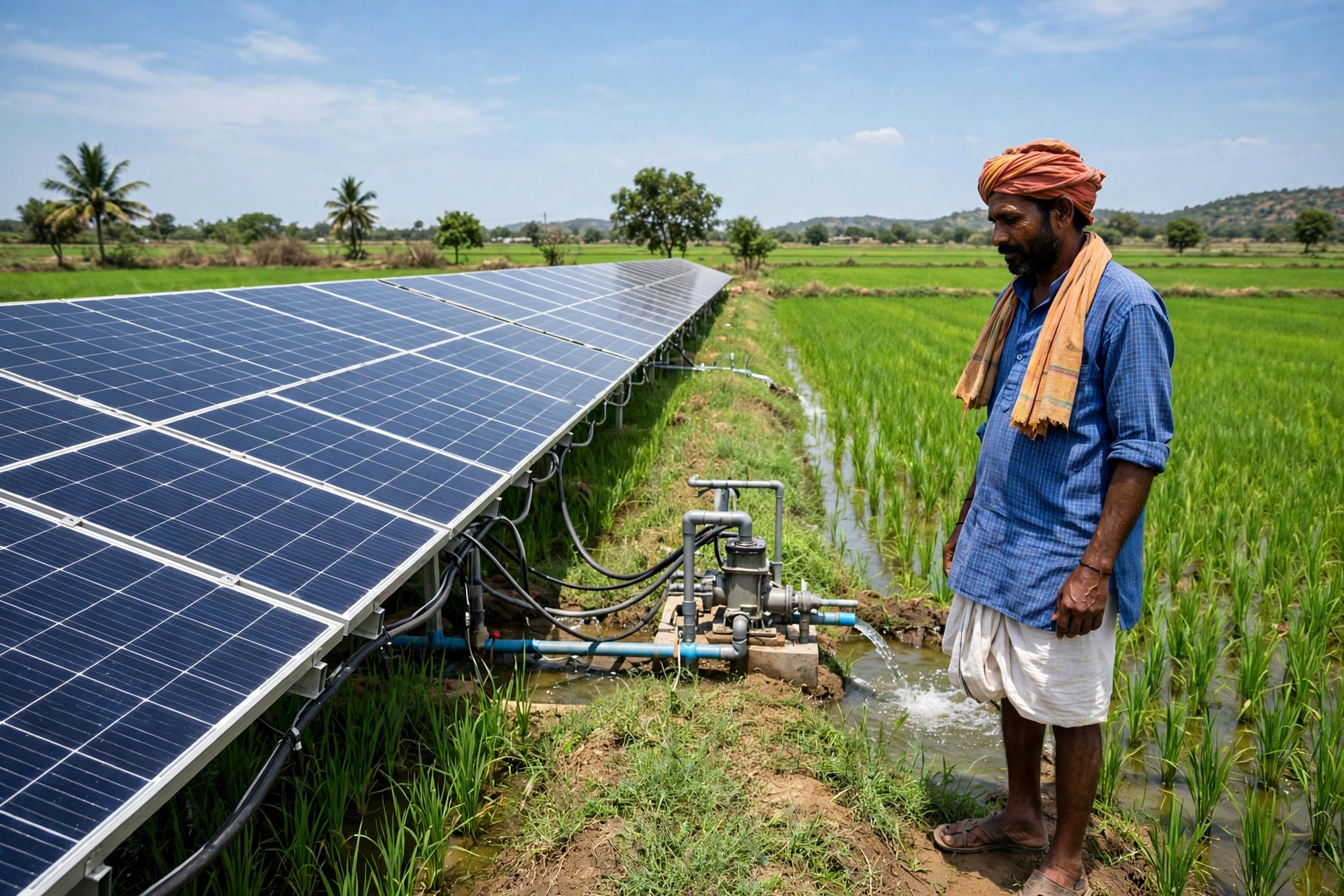
Component B is the part most farmers ask about: a standalone solar pump that runs directly on solar power, with no grid connection and no diesel. It suits farmers with no reliable grid connection, or who want to stop paying for diesel. For individual farmers, the standard size is up to 7.5 HP, decided on the water table, land and water needed. One condition matters: no new standalone pump is given for land that already has a grid-connected agriculture pump — except in dark-zone areas, where an existing standalone diesel pump can be converted to solar if the farmer also uses micro-irrigation.
Component C: solarising pumps that already have a grid connection
Component C is for farmers who already have an electricity connection for their pump. The pump is solarised — panels are installed so it runs on solar power during the day. It has two forms: Individual Pump Solarisation, for one farmer’s pump, and Feeder Level Solarisation, where a solar plant supplies a whole agricultural feeder. AP has said it is implementing feeder solarisation covering about 2.9 lakh pump sets. The difference is simple: Component B is for a new pump where there is no grid pump; Component C is for a pump that already has a connection — applying under the wrong component is a common reason for rejection.
How much subsidy does a farmer get?
For Component B and individual pump solarisation under Component C, MNRE gives central assistance of 30% of its benchmark cost or the tender price, whichever is lower. The state must provide at least 30% more, and the farmer pays the balance. In the North Eastern states, Sikkim, Jammu and Kashmir, Ladakh, Himachal Pradesh, Uttarakhand, Lakshadweep and the Andaman and Nicobar Islands, it is 50% instead. Andhra Pradesh is not in that list, so the standard 30% applies here.
Where the state gives its full share, the two governments cover about 60% and the farmer pays up to 40%, often partly as a bank loan, so the upfront cash can be much less.
Two warnings matter. First, the scheme can run without the state share; then central assistance stays at 30% and the farmer bears 70% — so never assume 60% until the current AP notification confirms the state share. Second, the subsidy is calculated on the MNRE benchmark cost or the tender price, whichever is lower, not on a vendor’s quote. For feeder-level solarisation, central assistance is ₹1.05 crore per MW, with no mandatory state support.
No AP-specific order confirming the exact state share for the current round was available when this was written — confirm it from the NREDCAP or DISCOM notice before paying anything.
Who can apply for PM KUSUM in AP?
Open to individual farmers, groups, farmer producer organisations, panchayats, cooperatives and water user associations, for irrigation. For Component B, the land should not already have a grid-connected agriculture pump. For Component C, the farmer must already have one, from APSPDCL, APEPDCL or APCPDCL. Selection is done by the State Implementing Agency, and applications open only when it announces district targets.
Horticulture farmers: our Horticulture Schemes in AP 2026 guide explains the drip subsidy and crop support that pair with a solar pump.
PM KUSUM and free power: how they fit together
AP farmers already get 9 hours of free electricity for agriculture — so why pay for a solar pump? The two solve different problems. Free power covers grid electricity for a pump connection, but not a farmer with no connection, a field far from the grid, or a need for daytime water when supply hours do not match the crop. A standalone solar pump gives water during the day, when the sun is up and the crop needs it.
How to apply for PM KUSUM in AP
There is no all-year window: applications open when NREDCAP, the DISCOM or the Agriculture Department announces district targets.
Step 1: Check whether applications are open in your district. Check the NREDCAP website or your district NREDCAP or DISCOM office: are applications open, for which component and pump capacities? Do not use a private website claiming to be the KUSUM portal.
Step 2: Decide which component fits you. Component B for a new standalone pump with no grid pump on that land; Component C to solarise an existing grid-connected pump; Component A only for barren or fallow land.
Step 3: Apply through the channel named in the notification. Apply to the State Implementing Agency — NREDCAP with the DISCOMs and the Agriculture Department — as the notification says: district office, DISCOM office, or the national PM-KUSUM portal. Keep the acknowledgement number.
Step 4: Wait for feasibility checking and selection. The agency checks the land, water table, connection and site feasibility; selection is its responsibility.
Step 5: Pay only your share, after sanction, to the authorised channel. Once sanctioned and a vendor is allotted, pay only your share. Never pay the full cost upfront to a private agent, or anyone promising guaranteed selection.
Step 6: Get the pump installed and inspected. The empanelled vendor installs the pump and panels, and the system is inspected before handover. Keep the sanction letter, receipts and warranty papers.
The national portal is pmkusum.mnre.gov.in. MNRE warns against fake websites taking money in the name of PM-KUSUM; its toll-free number is 1800-180-3333.
What a solar pump actually saves
A diesel pump costs money every hour it runs. A solar pump has a high one-time cost — reduced by the subsidy — and then almost no running cost, so the saving is biggest for farmers who irrigate often, run a diesel pump today, or grow water-hungry crops. It also gives water in the daytime, when the farmer can watch it. Keep your other papers in order too: the Annadata Sukhibhava guide covers the ₹20,000 annual support for farmer families, and the PM Fasal Bima guide covers crop insurance.
Mistakes to avoid
Do not confuse PM KUSUM with PM Surya Ghar: Surya Ghar is a rooftop solar subsidy for houses, of up to ₹78,000, with its own portal, and cannot be claimed for a farm pump. See our PM Surya Ghar in AP guide. Do not pay an agent — selection is done by the State Implementing Agency, and no agent can guarantee it. Do not buy from an unlisted vendor on the promise of a subsidy; it is paid only on systems installed through the authorised process. And do not apply for a pump far bigger than your need — the extra cost beyond the benchmark is yours.
Frequently asked questions
Is PM KUSUM the same as PM Surya Ghar?
No. PM Surya Ghar subsidises rooftop solar on houses; PM KUSUM is for farmers — standalone solar pumps, solarising grid-connected pumps, and small solar plants. Different portals, subsidies and eligibility.
How much subsidy will I get on a solar pump in AP?
The Centre gives 30% of the benchmark cost or tender price, whichever is lower, and the state must give at least 30% more — about 60% in total where the state share is given in full, with the farmer paying up to 40%. Confirm the state share from the current NREDCAP or DISCOM notification.
I already get 9 hours of free power. Should I still apply?
It depends on your field. If your grid connection works and the supply hours suit your crop, free power may be enough. Otherwise — no connection, a field far from the grid, a diesel pump, or a need for daytime water — a solar pump is worth considering. Talk to your DISCOM office first.
Where do I apply in AP?
Through the State Implementing Agency — NREDCAP, with your DISCOM (APSPDCL, APEPDCL or APCPDCL) and the Agriculture Department. Applications open district by district when targets are announced; check the NREDCAP website or your district office, and use only pmkusum.mnre.gov.in.
The bottom line
PM KUSUM in AP is a practical scheme, not a free pump. The government pays a large part of the cost — 30% from the Centre, with at least 30% more expected from the state — and the farmer pays the rest, for a pump that runs on sunlight for years. But the subsidy, pump size and window all depend on the current AP notification. Check with NREDCAP or your DISCOM first, apply through the official channel, and pay nothing to anyone promising a guaranteed pump.

Venkatesh is the Content Lead and Researcher at UNQ Information. He researches government schemes, pension programs, citizen services, and welfare initiatives related to Andhra Pradesh and Telangana. He regularly publishes updates and educational content to help readers understand eligibility criteria, required documents, application procedures, benefit details, and important government announcements in a simple and easy-to-understand format.