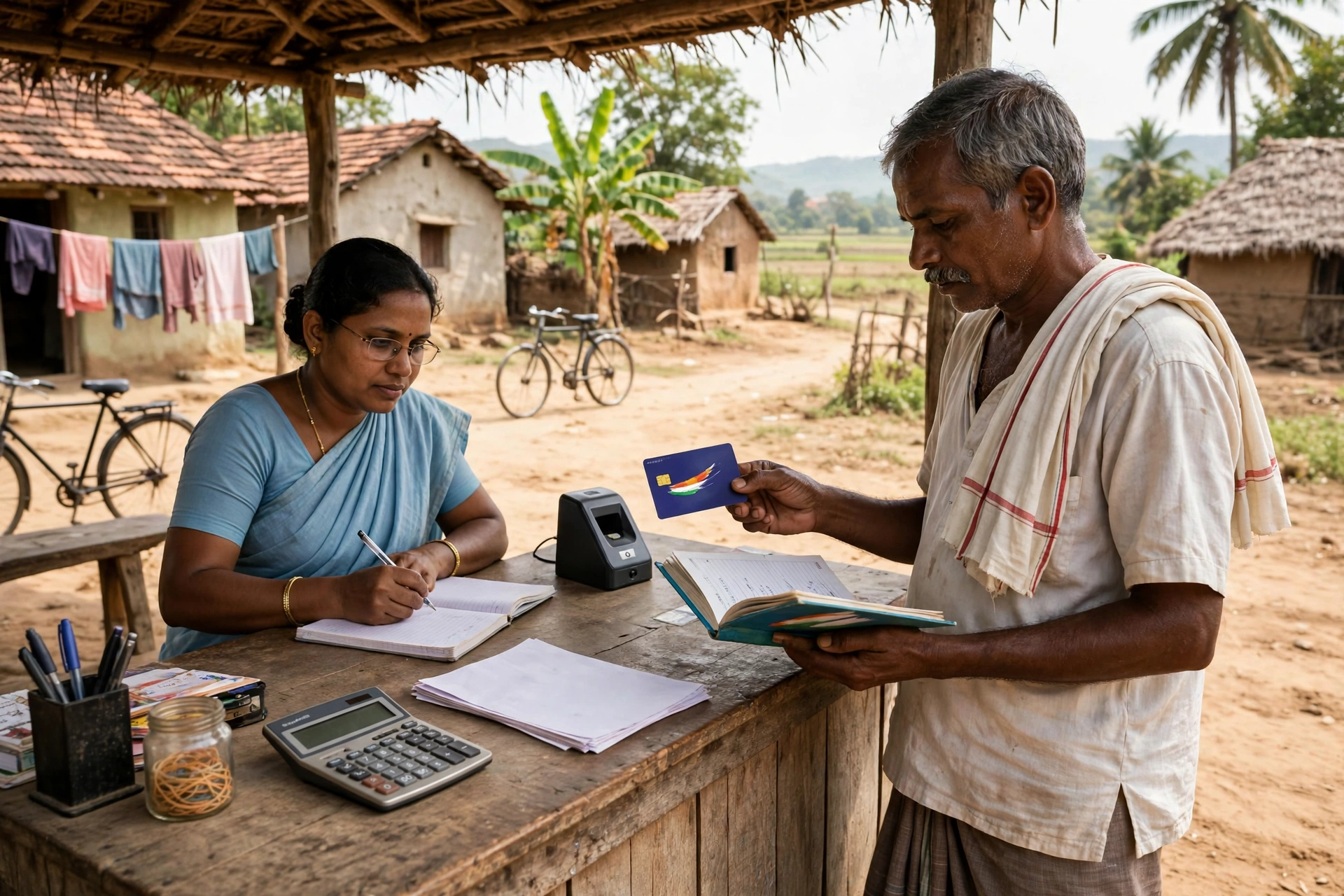

If you do not have a bank account, almost every government scheme in Andhra Pradesh is hard to receive. Talliki Vandanam, Annadata Sukhibhava, NTR Bharosa pension and PM-Kisan are all paid by Direct Benefit Transfer (DBT) into a bank account. No account, no payment. The Pradhan Mantri Jan Dhan Yojana (PMJDY) solves exactly this: a savings account with zero minimum balance, a free RuPay card and accident insurance, with no opening fee.
This guide explains the PM Jan Dhan Yojana in AP in plain words: what you get, who can open an account, which documents you need, and the steps at the bank.
What is PM Jan Dhan Yojana?
Pradhan Mantri Jan Dhan Yojana is the Government of India’s National Mission for Financial Inclusion. It was launched by Prime Minister Narendra Modi on 28 August 2014 and is run by the Department of Financial Services, Ministry of Finance. Its aim: every household should have access to a basic savings account, remittance, credit, insurance and pension, affordably.
Under it, a Basic Savings Bank Deposit (BSBD) account can be opened at any bank branch or Bank Mitra outlet by a person with no other bank account. The scheme completed 12 years in August 2026. According to the Press Information Bureau, PMJDY accounts across India stood at 59.09 crore as on 19 August 2026, holding deposits of ₹3.17 lakh crore. 55.7 percent of holders are women, and 77.8 percent of accounts are in rural and semi-urban areas.
What you get with a PM Jan Dhan Yojana in AP account
A PM Jan Dhan Yojana account in AP gives you these benefits, as stated on the official PMJDY scheme page:
- Zero-balance savings account. No minimum balance is required, and you are not fined for a zero balance. Your deposit earns savings-bank interest.
- Free RuPay debit card. Every account holder gets a RuPay card for ATM withdrawals and shop payments.
- Accident insurance cover of ₹2 lakh. The RuPay card carries accident insurance of ₹1 lakh, raised to ₹2 lakh for accounts opened after 28 August 2018. This is insurance cover, not cash — paid only on accidental death or permanent total disability.
- Overdraft up to ₹10,000. Eligible account holders can get an overdraft of up to ₹10,000 — explained below.
- Direct Benefit Transfer. Scheme money from the Centre and the state government comes directly into your Jan Dhan account. Your account, Aadhaar and mobile number form the JAM trinity that carries these payments — the government says more than ₹53 lakh crore has been transferred directly to beneficiaries through JAM so far.
- A door to other schemes. A PMJDY account makes you eligible to join PM Jeevan Jyoti Bima Yojana, PM Suraksha Bima Yojana, Atal Pension Yojana and the MUDRA loan scheme.
PM Jan Dhan Yojana in AP: how big is it here?
The Finance Ministry told the Lok Sabha that AP had about 1.57 crore PMJDY accounts as on 26 February 2025 — roughly one for every three people in the state.
Why does this matter? Nearly every AP scheme payment — including Talliki Vandanam and Annadata Sukhibhava instalments — now travels through a bank account, and when an instalment is delayed, the usual reason is a problem with the receiving account — not Aadhaar-seeded, NPCI mapping pointing to another bank, or the account gone dormant. An Aadhaar-seeded Jan Dhan account that is used regularly avoids most of these problems. If your scheme money has ever failed, read our guide on Aadhaar–bank seeding and NPCI mapping first.
Who can open a PM Jan Dhan Yojana in AP account?
Any Indian resident who does not already have a bank account can open a PMJDY account. There is no income limit. Open it at the bank branch nearest your village or town, or at a Bank Mitra outlet. One person should normally hold one Jan Dhan account; if you already have a regular savings account, the bank will usually ask you to use that instead — ask at your branch.
Documents you need
You need one officially valid document for identity and address proof, plus a passport-size photograph and the form. Aadhaar is preferred because it covers identity, address and DBT linking in one document. No income proof or agent is needed.
- Aadhaar card — the simplest choice, one document for identity, address and DBT linking.
- If you do not have Aadhaar: any one of these works — passport, driving licence, voter ID, NREGA job card, or National Population Register letter — plus your PAN card or Form 60.
- No document at all? You can still open a “small account” (Chota Khata) with just a self-attested photograph and your signature or thumb impression before the bank officer. It is valid for 12 months, extendable by 12 more if you show proof of having applied for an officially valid document. Small accounts have balance and transaction limits, so get Aadhaar made and upgrade as soon as you can.
The form is free at the branch and on the official PMJDY website, in Hindi and English.
How to open a Jan Dhan account: step by step
There is no fully online way to open one — you must visit a bank branch or Bank Mitra outlet in person once, so the bank can verify your identity.
- Go to the nearest bank branch or Bank Mitra outlet. Any public sector bank, regional rural bank, private bank or post office can open one. Take your Aadhaar card (or other document) and one photograph.
- Ask for the PMJDY account opening form. Say you want a Jan Dhan account. The form is free.
- Fill the form. Write your name, address, date of birth, mobile number and nominee details, then sign or give a thumb impression. If you cannot read or write, staff will help — but check the name spelling and mobile number before signing.
- Submit the form with your documents. Give a photocopy of your document and your photograph. The bank will do e-KYC, usually with an OTP or a fingerprint.
- Get your passbook and RuPay card. You get a passbook at once, and the RuPay card is usually issued with the account or sent shortly after. Keep its PIN secret — never share it, even with bank staff.
- Link your Aadhaar and mobile number. Ask the bank to seed your Aadhaar number and link your mobile number — this is what makes DBT payments reach you. If a scheme payment fails later, check this first.
The ₹10,000 overdraft: how it really works
After six months of satisfactory operation, you can get an overdraft of up to ₹10,000. Only one account per household can get it, preferably the woman’s, and the age limit is 18 to 65 years.
An overdraft is credit, not free money: the bank lets you withdraw up to ₹10,000 more than your balance in an emergency, and you must repay it with interest — unpaid amounts are recovered from future deposits. The bank decides the amount from how regularly you used the account, so do not expect it on day one.
Three cheap covers you can add to the same account
Once your account is running, you can join three low-cost schemes from it. Premiums are auto-debited yearly, so keep enough balance:
- Pradhan Mantri Jeevan Jyoti Bima Yojana (PMJJBY): ₹2 lakh life cover on death from any cause, ages 18–50, at ₹436 a year.
- Pradhan Mantri Suraksha Bima Yojana (PMSBY): ₹2 lakh for accidental death or total disability, ₹1 lakh for partial disability, ages 18–70, at ₹20 a year.
- Atal Pension Yojana (APY): a guaranteed pension of ₹1,000–₹5,000 a month from age 60, based on joining age and contribution. Entry age 18–40.
All three launched on 9 May 2015; enrol through your bank, with forms and rules on the Jan Suraksha portal. They are worth having: a fisherman with GAIS accident insurance can still hold PMSBY, and a small trader can combine a Jan Dhan account with a MUDRA loan.
Keep your account active and safe
An unused account becomes a problem: banks mark accounts inoperative after long periods with no transactions, and scheme payments can fail. Use the RuPay card at least once every 90 days; keep your mobile number updated, because OTPs and DBT alerts go to the registered number; and update your passbook to check that scheme money such as PM-Kisan instalments is credited into your PM Jan Dhan Yojana in AP account.
Two warnings. Never pay anyone to open the account — it is free; if an agent demands money, complain to the bank manager or call the toll-free helpline 1800 11 0001 or 1800 180 1111. And never share your PIN, OTP or card details: no bank or government office will ever ask for them on a call.
Frequently asked questions
Is a Jan Dhan account really zero-balance?
Yes. No minimum balance is required and no penalty is charged for a zero balance — and your deposit still earns interest.
I already have a savings account. Can I still open a Jan Dhan account?
The scheme is for people with no bank account. If you already have one, DBT payments can usually go into it instead — what matters is that it is Aadhaar-seeded and active.
What is the ₹2 lakh benefit — do I get ₹2 lakh in my account?
No. It is insurance cover on the RuPay card (₹2 lakh for accounts opened after 28 August 2018, ₹1 lakh for older ones), paid to the nominee only on accidental death or permanent total disability — not cash in the account.
Can I open a Jan Dhan account online?
No. You must visit a branch or Bank Mitra outlet once for identity verification, but you can download the form from the official PMJDY website first.
Does the Jan Dhan account help me get scheme money faster?
In one way: DBT payments from PM-Kisan, Talliki Vandanam and Annadata Sukhibhava go straight to the beneficiary’s bank account, and an Aadhaar-seeded Jan Dhan account is the simplest account to receive them in. But it does not make you eligible for any scheme — each has its own rules.
A Jan Dhan account will not make anyone rich — that is not its job. Its job is to make sure that when the government sends you money, there is a working account in your name to receive it: no minimum balance, a free RuPay card, and ₹2 lakh of accident cover. If anyone in your family still has no bank account, take your Aadhaar card and a photograph to the nearest branch or Bank Mitra outlet this week and open one.

Venkatesh is the Content Lead and Researcher at UNQ Information. He researches government schemes, pension programs, citizen services, and welfare initiatives related to Andhra Pradesh and Telangana. He regularly publishes updates and educational content to help readers understand eligibility criteria, required documents, application procedures, benefit details, and important government announcements in a simple and easy-to-understand format.