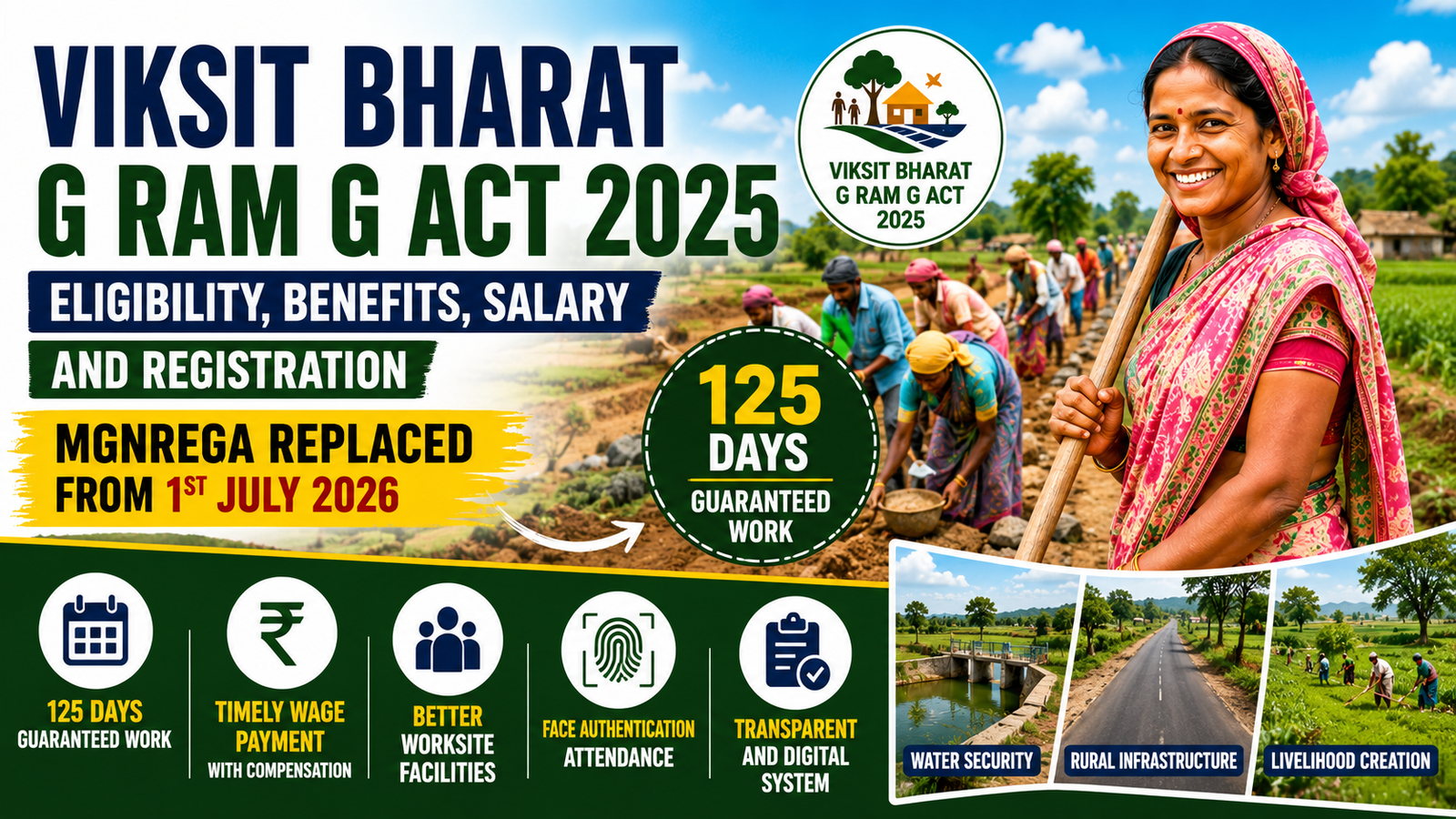

India’s rural employment policy has entered a new phase with the introduction of the Viksit Bharat – Guarantee for Rozgar and Ajeevika Mission (Gramin) Act, 2025, commonly referred to as theViksit Bharat G RAM G Act 2025.
The legislation represents one of the most significant reforms in rural employment since the launch of the Mahatma Gandhi National Rural Employment Guarantee Act (MGNREGA) in 2005. The new framework expands guaranteed employment from 100 days to 125 days per rural household and integrates employment generation with infrastructure development, climate resilience, digital governance, and long-term rural economic growth.
The Act aims to strengthen income security while ensuring that public expenditure contributes to productive assets that improve agriculture, water conservation, connectivity, and rural livelihoods.
Why Was a New Rural Employment Law Introduced?
MGNREGA played a crucial role in providing employment opportunities and supporting rural households for nearly two decades. However, the Government noted that rural India has undergone substantial changes since 2005.
According to official data cited in the policy framework, poverty levels declined significantly, digital infrastructure expanded rapidly, financial inclusion improved through bank accounts and Aadhaar-linked services, and rural livelihoods became increasingly diversified.
The Government argues that a modernized employment framework is necessary to align rural employment programs with the vision of Viksit Bharat 2047.
➤ Read Also: Mahalakshmi Scheme Telangana 2026: Eligibility, Benefits & Latest Updates
125 Days Employment Guarantee
One of the most important changes under the G RAM G Act is the increase in guaranteed employment.
Previous Framework
- MGNREGA: 100 days of employment per rural household per year
New Framework
- G RAM G Act 2025: 125 days of employment per rural household per year
The additional 25 days of guaranteed work is intended to provide greater income security and improve household earnings in rural areas.
The Act also allows for designated no-work periods during peak agricultural seasons to ensure adequate labour availability for farming activities.
Eligibility Criteria
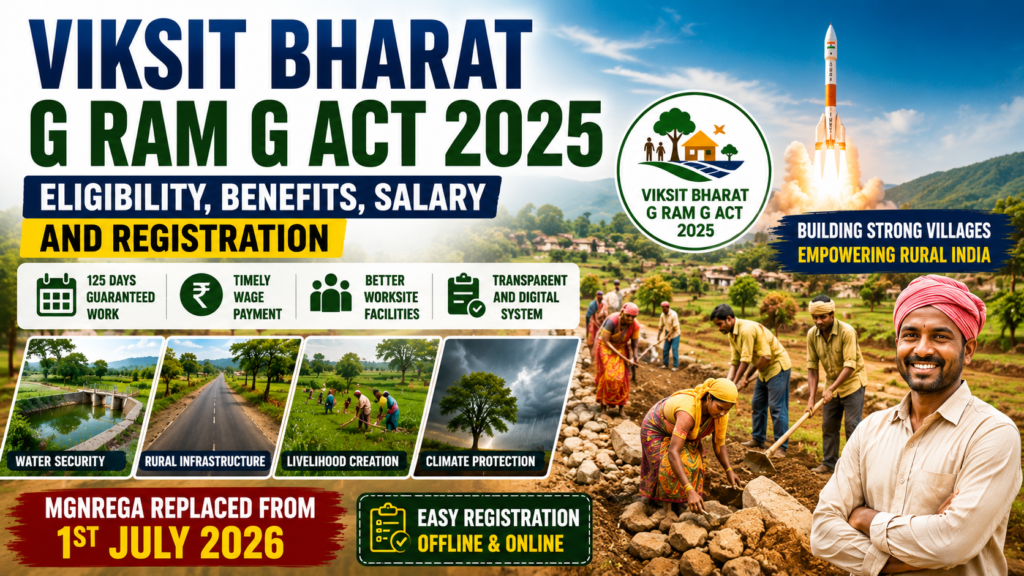
The scheme is primarily intended for rural households whose adult members are willing to undertake unskilled manual work. Agricultural labourers, landless workers, small and marginal farmers, women workers, and economically vulnerable families are expected to be among the major beneficiaries. Registration and verification are likely to be carried out through Gram Panchayats and local authorities.
MGNREGA vs G RAM G Table
| Feature | MGNREGA | G RAM G Act 2025 |
|---|---|---|
| Employment Days | 100 Days | 125 Days |
| Wage Payment | Digital Payments | DBT-Based Payments |
| Monitoring | Traditional + Digital | AI, GPS, Biometrics |
| Focus | Employment | Employment + Infrastructure |
| Climate Works | Limited | Dedicated Category |
Wage Payments Through Direct Benefit Transfer (DBT)
One of the biggest improvements under the Viksit Bharat G RAM G Act 2025 is the wage payment system. Workers no longer need to depend on delayed manual payment processes. The government plans to transfer wages directly to beneficiaries’ bank accounts through Direct Benefit Transfer (DBT). Payments are expected to be made weekly or within 15 days of completing the work, ensuring greater transparency and reducing payment-related complaints.
Four Priority Areas of Work
Unlike earlier employment programs that primarily focused on providing wage opportunities, the Viksit Bharat G RAM G Act 2025 links employment generation with long-term rural development. The objective is to ensure that public funds create productive assets that continue to benefit villages, farmers, and local communities even after the work is completed.
1. Water Security
Water security has been identified as one of the most important priorities under the Act. Employment funds can be used for the construction of water harvesting structures, check dams, farm ponds, groundwater recharge systems, and irrigation support assets. These projects are intended to improve water availability, strengthen agricultural productivity, and enhance drought resilience in rural areas.
2. Core Rural Infrastructure
The Act supports the creation of essential rural infrastructure that can improve connectivity and access to public services. This includes village roads, rural transport links, public utility infrastructure, and community assets. Better infrastructure can help reduce travel time, improve access to markets, and support local economic activity.
3. Livelihood Infrastructure
A major focus of the new framework is the creation of assets that directly support rural livelihoods. Projects may include storage facilities, rural marketplaces, agricultural production assets, and other infrastructure that helps farmers and rural entrepreneurs improve productivity, reduce post-harvest losses, and increase income opportunities.
4. Climate Resilience Works
The Act also prioritizes projects that help villages adapt to climate-related challenges. Soil conservation measures, flood management systems, drought mitigation projects, water conservation initiatives, and climate adaptation infrastructure can help rural communities become more resilient to extreme weather events while protecting agricultural resources.
➤ Read Also: Raithu Bharosa Scheme 2026: Eligibility, Benefits & Payment Status
Funding Pattern and Budget
The financial architecture of the new Act introduces a structured cost-sharing framework.
Estimated Annual Requirement
- Total estimated annual expenditure: ₹1,51,282 crore
Estimated Central Government Share
- Approximately ₹95,692 crore
Funding Pattern
| Category | Centre Share | State Share |
|---|---|---|
| General States | 60% | 40% |
| North Eastern States | 90% | 10% |
| Himalayan States | 90% | 10% |
| Union Territories (without legislature) | 100% | 0% |
This model seeks to balance national funding support with state-level accountability.
Why MGNREGA Was Replaced?
According to the Government, rural India has changed significantly since MGNREGA was introduced in 2005. Poverty levels declined from 27.1% in 2011-12 to 5.3% in 2022-23, digital banking became widespread, and rural livelihoods became more diversified. These changes prompted the Government to introduce a framework that combines employment generation with infrastructure creation and long-term rural development.
Women’s Participation in Rural Employment
Women’s participation in rural employment programmes increased from around 48% in FY 2013-14 to more than 58.15% in FY 2025-26. This highlights the growing importance of employment guarantee programmes for women in rural India.
Administrative Reforms Under the New Act
The Act increases the administrative expenditure ceiling from 6% to 9%. This additional allocation is intended to strengthen staffing, training, technical support, monitoring systems, and implementation capacity at the local level.
How Much Can a Family Earn?
Actual earnings depend on the wage rate notified by each State Government. For example, if the average wage rate is ₹300 per day, a household completing all 125 days of employment could earn approximately ₹37,500 during a financial year. Actual earnings may vary depending on state wage rates and days worked.
➤ Check Also: Adabidda Nidhi Scheme 2025: Eligibility, Benefits, Documents & Latest Updates
Possible Challenges
While the Act introduces several reforms, its success will depend on effective implementation. Challenges may include timely release of funds, adequate staffing at the local level, accurate worker registration, digital infrastructure availability, and the effectiveness of social audits. Addressing these issues will be important to ensure that the intended benefits reach eligible rural households.
Benefits for Rural Workers
One of the biggest advantages of the Viksit Bharat G RAM G Act 2025 is the increase in guaranteed employment from 100 days to 125 days per household. This change can provide additional earning opportunities for rural families that depend on seasonal employment and agricultural work.
The Act also aims to improve wage payment efficiency through Direct Benefit Transfer (DBT), ensuring that wages are credited directly to workers’ bank accounts. According to the framework, payments are expected to be made weekly or within 15 days of work completion, reducing delays that were often reported under previous systems.
Another important feature is the provision of unemployment allowance. If eligible workers are not provided employment within the prescribed period after requesting work, the concerned State Government may be required to pay unemployment allowance as per applicable rules.
To improve transparency and reduce irregularities, the Act introduces technology-driven monitoring mechanisms, including GPS tracking, biometric verification, digital attendance systems, and real-time reporting dashboards. These measures are intended to strengthen accountability and ensure that benefits reach genuine beneficiaries.
Benefits for Farmers
The G RAM G Act 2025 is expected to benefit farmers by creating productive assets that support agriculture and water management. Investments in irrigation infrastructure, groundwater recharge projects, rural roads, and storage facilities can improve farm productivity and market access. The Act also allows designated no-work periods during peak sowing and harvesting seasons, helping farmers address labour availability concerns during critical agricultural operations.
➤ Read Also: Talliki Vandanam Scheme 2026: Eligibility, Benefits & Latest Updates
official links
| Action | Link |
|---|---|
| PIB Detailed Explainer | Read Explainer |
| PIB Frequently Asked Questions | View FAQ |
| Ministry of Rural Development | Visit Website |
| MGNREGA Official Portal | Open Portal |
| National Government Services | Visit Portal |
| PRS India Bill Tracker | Track Bill Status |
Technology and Monitoring Framework
Unlike earlier rural employment programs, the G RAM G Act introduces GPS tracking, biometric verification, and AI-assisted monitoring to improve accountability. The government expects these systems to reduce ghost beneficiaries, strengthen attendance verification, and improve transparency in public expenditure.
MGNREGA vs G RAM G Act 2025
| Feature | MGNREGA | G RAM G Act 2025 |
|---|---|---|
| Employment Guarantee | 100 Days | 125 Days |
| Planning Framework | Traditional | Integrated Development Planning |
| Wage Payments | Digital Expansion Phase | DBT-Centric Framework |
| Technology Usage | Limited Digital Monitoring | AI, GPS, Biometrics |
| Climate Resilience | Limited Focus | Dedicated Priority Area |
| Infrastructure Integration | Moderate | Core Objective |
| Administrative Capacity | Existing Framework | Expanded Administrative Support |
Key Highlights of the G RAM G Act 2025
- 125 days of guaranteed employment per rural household.
- Estimated annual funding requirement of ₹1.51 lakh crore.
- Direct Benefit Transfer (DBT) for wage payments.
- Water conservation and climate resilience projects.
- GPS, AI and biometric-based monitoring systems.
- Provision for unemployment allowance when work is unavailable.
Frequently Asked Questions
1.How many days of employment are guaranteed?
Eligible rural households can receive up to 125 days of guaranteed employment annually.
2.How are wages paid?
Wages are transferred directly to beneficiaries through DBT-enabled bank accounts.
3.Is Aadhaar required?
Aadhaar-linked systems are expected to play a key role in verification and payment processing.
4.Can women participate?
Yes. Women remain eligible beneficiaries under the employment framework.
5.What happens if employment is not provided?
The Act includes provisions for unemployment allowance, subject to applicable rules and conditions.
Conclusion
The Viksit Bharat G RAM G Act 2025 represents a major transformation in India’s rural employment policy. By increasing guaranteed employment from 100 to 125 days, introducing a funding framework of approximately ₹1.51 lakh crore annually, strengthening digital governance, and linking employment with infrastructure creation, the legislation seeks to create a more productive and accountable rural development model.

Venkatesh is the Content Lead and Researcher at UNQ Information. He researches government schemes, pension programs, citizen services, and welfare initiatives related to Andhra Pradesh and Telangana. He regularly publishes updates and educational content to help readers understand eligibility criteria, required documents, application procedures, benefit details, and important government announcements in a simple and easy-to-understand format.