

Owning a permanent house remains a dream for millions of rural families across India. Rising construction costs, limited income sources, and lack of access to affordable housing finance make it difficult for economically weaker households to build a safe and secure home.
To address this challenge, the Government of India launched the Pradhan Mantri Awas Yojana – Gramin (PMAY-G). The scheme aims to provide financial assistance to eligible rural families for constructing permanent houses with basic amenities. Through this initiative, beneficiaries receive housing assistance directly into their bank accounts in multiple installments linked to construction progress.
Many applicants search for PMAY-Gramin Scheme 2026 eligibility, beneficiary selection process, financial assistance, required documents, payment stages, and application status. This guide explains everything in a practical and easy-to-understand format.
Quick Scheme Overview
| Particulars | Details |
|---|---|
| Scheme Name | Pradhan Mantri Awas Yojana – Gramin (PMAY-G) |
| Implementing Authority | Government of India |
| Target Beneficiaries | Rural Homeless and Poor Families |
| Assistance Type | Housing Financial Assistance |
| Objective | Permanent Housing for Rural Families |
| Payment Mode | Direct Benefit Transfer (DBT) |
| Beneficiary Selection | SECC Data & Government Verification |
| Additional Benefits | Toilet, Electricity, LPG, Water Support |
What Is PMAY-Gramin Scheme?
PMAY-Gramin is a rural housing scheme designed to help eligible families construct permanent houses with basic facilities. The scheme primarily targets households living in kutcha houses, dilapidated structures, or without proper housing facilities.
Financial assistance is transferred directly to beneficiaries through the DBT system, ensuring transparency and reducing delays. The scheme focuses not only on housing construction but also on improving overall living standards by integrating other welfare initiatives.
➤ Related Scheme: Adabidda Nidhi Scheme 2025: Eligibility, Benefits, Documents & Latest Updates
Why Was PMAY-Gramin Introduced?
Many rural families continue to face housing insecurity due to limited financial resources.
Common challenges include:
- Lack of permanent housing
- Unsafe living conditions
- Exposure to weather-related risks
- Poor sanitation facilities
- Limited access to electricity and drinking water
- Dependence on informal borrowing for construction
PMAY-G aims to improve housing quality and provide a safer living environment for vulnerable households.
Financial Assistance Under PMAY-Gramin
Eligible beneficiaries receive housing assistance in multiple installments based on construction progress.
Housing Assistance Structure
| Construction Stage | Assistance Released |
| Foundation Stage | First Installment |
| Wall Construction | Second Installment |
| Roof Level Completion | Third Installment |
| Final Completion | Final Installment |
Apart from housing assistance, beneficiaries may also receive support through converged government schemes for:
- Toilet construction
- Rural employment support
- Electricity connection
- LPG connection
- Drinking water facilities
Key Benefits of PMAY-Gramin
The scheme provides several long-term benefits:
- Permanent housing support
- Improved living standards
- Safer housing structures
- Direct benefit transfer
- Support for sanitation facilities
- Reduced financial burden
- Better social security for families
- Improved quality of life
How Are PMAY-G Beneficiaries Selected?
PMAY-G beneficiaries are generally selected through Socio-Economic Caste Census (SECC) data and subsequent government verification. Local authorities verify housing conditions, family details, and eligibility before final approval.
The final beneficiary list is prepared according to government guidelines and approved by the concerned authorities.
Who Can Apply?
Potential beneficiaries generally include:
- Rural homeless families
- Families living in kutcha houses
- Economically weaker rural households
- Eligible households identified through government surveys
- Vulnerable sections including SC, ST, and other eligible categories
Beneficiary selection is based on official government criteria and verification.
➤ Read Also: Digital Lakshmi Scheme 2026: ₹2 Lakh Loan & Digital Jobs for Women
Who May Not Be Eligible?
Applicants may not qualify if:
- They already own a permanent house.
- They previously received housing assistance under similar schemes.
- Verification requirements are not satisfied.
- Incorrect information is provided.
- Duplicate beneficiary records are detected.
Documents Required
Applicants may require:
- Aadhaar Card
- Ration Card
- Residence Proof
- Income Certificate
- Bank Passbook
- Mobile Number
- Family Details
- Land Ownership Documents (where applicable)
Additional documents may be requested during verification.
How Beneficiary Verification Works
Step 1: Household Identification
Authorities identify eligible families through approved government databases and surveys.
Step 2: Aadhaar Verification
Beneficiary identity is authenticated.
Step 3: Bank Account Verification
DBT eligibility and account details are verified.
Step 4: Field Inspection
Officials may conduct physical verification of housing conditions.
Step 5: Final Approval
Eligible beneficiaries are included in the approved housing list.
Common Reasons Why Applications Are Delayed
Many applications face delays because of:
- Aadhaar mismatch
- Incorrect bank details
- Incomplete documents
- Land ownership disputes
- Pending verification
- Duplicate records
- Mobile number issues
Keeping records updated can help avoid unnecessary delays.
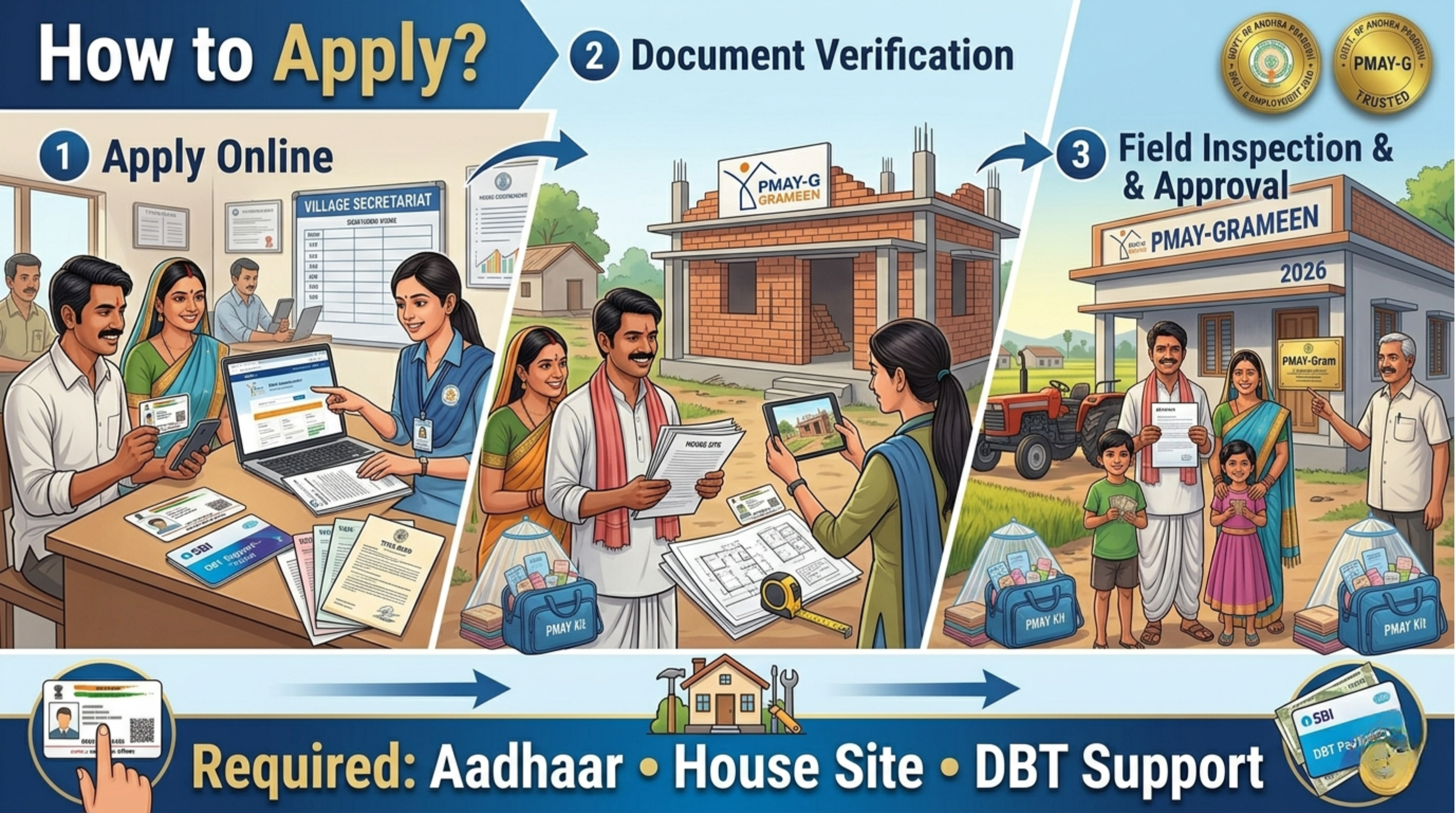
How to Apply for PMAY-Gramin Scheme?
PMAY-Gramin beneficiary selection is generally based on government surveys and approved beneficiary lists. Eligible families should contact their Gram Panchayat, Village Secretariat, or local rural development authorities for guidance regarding inclusion and verification.
The application process may involve:
Step 1: Beneficiary identification through approved surveys
Step 2: Verification of family and housing details
Step 3: Aadhaar and bank account authentication
Step 4: Field-level inspection
Step 5: Final approval and inclusion in the beneficiary list
Applicants should ensure that all supporting records are accurate and updated before verification.
➤ SHG women interested in self-employment and digital entrepreneurship opportunities can also read our detailed guide on Digital Lakshmi Scheme 2026, which explains CSC center support, training programs, financial assistance, and eligibility requirements.
How to Check PMAY-Gramin Status
Applicants can check their status online using official PMAY-G resources.
Before checking status, keep the following ready:
- Aadhaar Number
- Registration Number
- Mobile Number
- Beneficiary Details
Status information generally includes approval stage, verification updates, and payment release details.
Beneficiary Checklist
Before verification, ensure:
✓ Aadhaar details are correct
✓ Bank account is active
✓ Mobile number is updated
✓ Required documents are available
✓ Land details are accurate
✓ Family information matches official records
✓ Verification requirements are completed
What Happens After Approval?
After approval, beneficiaries receive financial assistance in stages based on construction progress.
Authorities may periodically inspect the construction work before releasing subsequent installments. Beneficiaries should use the assistance amount for housing construction purposes and maintain records related to construction progress whenever required.
Regular monitoring helps ensure transparency and timely release of funds.
Additional Benefits Available to Beneficiaries
Many beneficiaries focus only on housing assistance and miss other available support.
Eligible families may also benefit from:
- Swachh Bharat Mission support
- MGNREGA wage assistance
- Rural electrification schemes
- LPG connection support
- Drinking water initiatives
These integrated benefits help improve overall living conditions.
What Type of Houses Qualify Under PMAY-G?
The scheme primarily targets families living in:
- Kutcha houses
- Dilapidated structures
- Single-room houses with poor conditions
- Families without permanent housing
Housing eligibility is assessed through official surveys and field verification.
Common Verification Mistakes
Many beneficiaries face delays because of avoidable errors.
Common examples include:
- Aadhaar and bank name mismatch
- Incorrect mobile number
- Incomplete family information
- Land ownership document issues
- Duplicate beneficiary records
- Missing supporting documents
Reviewing records carefully before verification can help avoid delays.
Impact of PMAY-Gramin
PMAY-Gramin has become one of India’s largest rural housing initiatives.
Key outcomes include:
- Increased access to permanent housing
- Improved sanitation facilities
- Better living conditions
- Reduced housing insecurity
- Enhanced rural infrastructure
- Improved quality of life for economically weaker households
➤ Unemployed youth seeking government welfare support can also read our detailed guide on Nirudhyoga Bruthi Scheme 2026 for eligibility criteria, required documents, verification process, and the latest updates.
Important Official Resources
| Action | Link |
|---|---|
| Official Government Website | Visit Portal |
| PMAY-G Portal | Check PMAY-G Details |
| Ministry of Rural Development | Visit Website |
| Aadhaar Services | Open UIDAI |
| DBT Payment Information | Check DBT Details |
Frequently Asked Questions
1.What is PMAY-Gramin Scheme?
PMAY-Gramin is a rural housing assistance scheme that supports eligible families in constructing permanent houses.
2.How is assistance provided?
Financial assistance is transferred directly into beneficiary bank accounts through DBT.
3.Who can receive benefits?
Eligible rural households identified through prescribed government criteria may receive assistance.
4.Is Aadhaar mandatory?
Aadhaar-based verification is generally used for beneficiary identification and payment processing.
5.Why is my application delayed?
Common reasons include Aadhaar mismatch, incorrect bank details, pending verification, or incomplete documentation.
6. Can I check whether my name is in the PMAY-G beneficiary list?
Yes. Beneficiaries can generally verify their inclusion through official PMAY-G resources, local authorities, Gram Panchayats, or Village Secretariats using beneficiary details and identification records.
Conclusion
PMAY-Gramin is an important housing initiative aimed at improving living conditions for rural families across India. By providing financial assistance for permanent housing and integrating additional welfare benefits, the scheme helps vulnerable households achieve greater housing security. Applicants should maintain accurate records, complete verification requirements, and regularly check official updates to ensure smooth processing of benefits.

Venkatesh is the Content Lead and Researcher at UNQ Information. He researches government schemes, pension programs, citizen services, and welfare initiatives related to Andhra Pradesh and Telangana. He regularly publishes updates and educational content to help readers understand eligibility criteria, required documents, application procedures, benefit details, and important government announcements in a simple and easy-to-understand format.
I’m SUCHARITHA Housewife I have two children’s my husband farmer I need own house pls help me govt
Simply wanna tell that this is extremely helpful, Thanks for taking your time to write this.