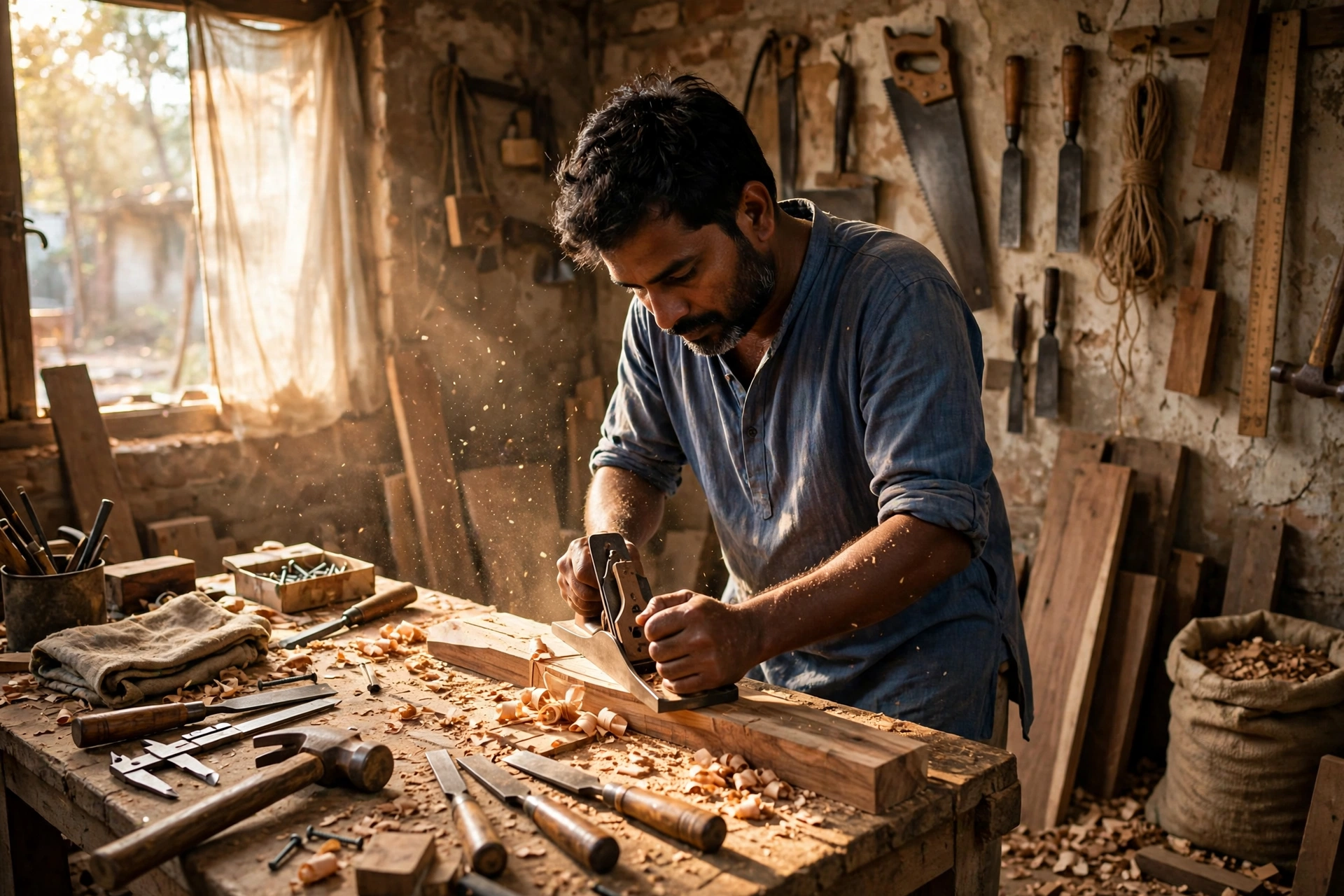

If you earn your living with your hands — carpenter, tailor, potter, blacksmith, mason, goldsmith — the central government has a scheme for you. PM Vishwakarma in AP is open to traditional artisans in Andhra Pradesh: an identity card for your trade, free skill training with a daily stipend, up to ₹15,000 for modern tools, and a collateral-free loan of up to ₹3 lakh at 5% interest. This guide starts with the money, then covers who can apply, what you get, and how to apply.
A carpenter’s first year: what the money actually looks like
The scheme lists many benefits. Here is what they add up to for one person.
Take a carpenter who finishes basic training and takes the first loan — an illustration, not a bank quote:
- Training stipend: 5 to 7 days at ₹500 a day — ₹3,500 for 7 days.
- Toolkit: an e-voucher of up to ₹15,000 at the start of training — not cash — for modern tools like power tools.
- First loan: up to ₹1 lakh over 18 months at 5%. On a simple-interest illustration, interest on ₹1,00,000 at 5% for 1.5 years is ₹7,500 — a total of about ₹1,07,500, or roughly ₹5,972 a month. Banks calculate instalments on a reducing balance, so the actual figure may differ — ask the bank for the exact EMI before you sign.
- Second loan: up to ₹2 lakh more over 30 months at 5%, after you repay the first loan well.
So the first year is a stipend, a tools voucher, and then a loan repaid monthly. The loan is not a grant — you must repay it, and the bank decides the sanction.
What PM Vishwakarma is
PM Vishwakarma is a Central Sector Scheme of the Ministry of Micro, Small and Medium Enterprises, launched on 17 September 2023. Its full name is PM Vishwakarma.
Lakhs of people do trades their families have done for generations. They have skill, but no certificate, no modern tools, and no easy bank loan. PM Vishwakarma gives them all of these together: recognition, training, tools, cheap credit and marketing help.
In AP it works the same way, because it is a central scheme: registration at CSCs, verification at Gram Panchayat and district level, and the loan from a bank.
The outlay for the whole country is ₹13,000 crore for 2023-24 to 2027-28, and the government aims to support 30 lakh artisans. Andhra Pradesh figures, from the Lok Sabha reply on the scheme, are:
- 21.67 lakh applications received in AP by 5 December 2025.
- 2,22,947 artisans registered in AP after verification.
- 1,70,205 loans sanctioned in AP, of which 1,24,512 were disbursed.
Registration is not automatic — apply with correct documents and follow up. For other business help, see our guide to MSME schemes in AP.
The 18 trades covered
The scheme covers only these 18 traditional, family-based trades — if your work is not in the list, you cannot apply:
Wood and boat work: Carpenter (Suthar/Badhai), Boat Maker. Iron and metal work: Armourer, Blacksmith (Lohar), Metal Artisan, Hammer and Tool Kit Maker, Locksmith. Gold and clay work: Goldsmith (Sonar), Potter (Kumhaar). Stone work: Sculptor (Moortikar, Stone Carver), Stone Breaker. Leather and construction work: Cobbler (Charmkar) / Shoesmith / Footwear Artisan, Mason (Rajmistri). Other traditional work: Basket / Mat / Broom Maker / Coir Weaver, Doll and Toy Maker (Traditional), Barber (Naai), Garland Maker (Malakaar), Washerman (Dhobi), Tailor (Darzi), Fishing Net Maker.
Can you apply?
You can apply if you meet all of these conditions:
- Age: at least 18 on the date of registration.
- Trade: You work with your hands and tools in one of the 18 trades above.
- Self-employed: You work on your own in the unorganised sector.
- Actively working: You are doing the trade now.
- One per family: Only one member can get benefits. Family means husband, wife and unmarried children.
- No recent similar loan: No loan under a similar credit-based government scheme — PMEGP, PM SVANidhi or Mudra — in the last five years. If you fully repaid a Mudra or PM SVANidhi loan, you may still be eligible; check the portal FAQ.
- No government job: You and your family members must not be in government service.
If a recent Mudra loan worries you, see our guides to the Mudra loan in AP and PMEGP in AP, and ask the CSC operator.
The six benefits, one by one
All the benefits come together; no single one is the scheme.
- Recognition. After verification, you get a certificate and identity card — official proof of your trade.
- Skill training. Basic training runs 5 to 7 days (about 40 hours) in your trade and in running a business; advanced training of 15 days or more (120 hours) is optional.
- Toolkit support. At the start of basic training, you get up to ₹15,000 as an e-voucher, not cash — for modern tools like an electric potter’s wheel or power tools.
- Loans at 5%. Two parts: up to ₹1 lakh over 18 months after basic training, then up to ₹2 lakh over 30 months once you repay the first loan well and adopt digital transactions or complete advanced training. You pay only 5% interest; the government pays up to 8% subvention to the bank. No collateral is needed. But this is a loan, not a grant — you must repay it, and the bank decides the sanction.
- Incentive for digital transactions. ₹1 per eligible digital transaction, up to 100 a month, credited to your bank account.
- Marketing support. The scheme helps you reach more customers through government e-marketplaces and branding support; registered artisans are onboarded onto the Udyam Assist Platform.
Papers to carry to the CSC
- Aadhaar card — mandatory, for e-KYC and biometric authentication.
- Mobile number linked with Aadhaar — for OTP verification and messages.
- Bank account details — passbook or account number with IFSC code. Link the account with Aadhaar, because all payments come through Direct Benefit Transfer. If scheme money has failed to reach you before, read our guide on Aadhaar bank seeding and NPCI mapping.
- Ration card — for family verification; if you have none, use the Aadhaar cards of all family members instead.
- Proof of your trade — photographs of your work, tools or workshop.
- Passport-size photograph — for the ID card. Caste certificate — only if applicable.
No bank account? The CSC can help you open one.
Your visit to the CSC, in eight steps
Step 1 — Find your nearest CSC. Search on pmvishwakarma.gov.in or ask at your Grama Sachivalayam — in villages, the CSC is often near it: Grama / Ward Sachivalayam.
Step 2 — Carry your documents. Carry the papers listed above — Aadhaar, bank passbook, mobile number and ration card — the originals, not photos on your phone.
Step 3 — Register at the CSC. The operator registers you on the portal; your Aadhaar is verified with an OTP and fingerprint on the CSC machine — this step cannot be skipped.
Step 4 — Give your trade and bank details. The operator enters your trade, bank and family details. Check everything on screen before submitting — a wrong trade name or account number delays your application.
Step 5 — Verification in three stages. Your application is checked by the Gram Panchayat or Urban Local Body, then the district authority, then the state screening committee — most delays happen here.
Step 6 — Certificate and ID card. Once all three stages approve, you become a registered Vishwakarma and get your certificate and ID card.
Step 7 — Training and toolkit. You attend basic training of 5 to 7 days, get ₹500 per day, and receive the toolkit e-voucher of up to ₹15,000.
Step 8 — Loan. After training, apply for the first loan of up to ₹1 lakh through your bank; after repaying it well, apply for the second loan of up to ₹2 lakh.
If your application gets stuck
Check your status first: log in at pmvishwakarma.gov.in with your Aadhaar-linked mobile number, or ask the CSC operator to check it. Find out whether it is pending at the Gram Panchayat, district or state committee.
If it is rejected, ask why. Common reasons: a trade not in the list of 18, a government job in the family, a Mudra or PMEGP loan in the last five years, or an Aadhaar or bank detail mismatch. Fix it and apply again if the rules allow.
Questions people ask
Q1. Do I need to be a graduate or have any certificate to apply?
No. There is no education requirement — you need to be 18 or older, work in one of the 18 notified trades, and have documents to prove it.
Q2. Can I apply from my phone?
No. Registration needs Aadhaar biometric verification on a fingerprint machine, available only at a CSC.
Q3. I have a Mudra loan already. Can I apply?
Probably not yet. You must not have taken a loan under a similar credit-based scheme — PMEGP, PM SVANidhi or Mudra — in the last five years. If you fully repaid a Mudra or PM SVANidhi loan, ask the CSC operator to check.
Q4. My trade is not in the list of 18. What do I do?
Only the 18 notified trades are covered. If your trade is not in the list, try the Mudra loan or PMEGP, open to many kinds of small businesses.
Three things this scheme is not
Not a free grant. The loans must be repaid. The government pays up to 8% interest subvention and gives the toolkit e-voucher and the training stipend, but the loan itself comes back to the bank.
Not an online application. You cannot apply from home, because Aadhaar biometric verification needs a CSC machine.
Not open to everyone. Only the 18 notified trades are covered, and you must not hold a government job or have taken a similar credit-based loan in the last five years.
Apply only on the official portal, pmvishwakarma.gov.in — never enter your Aadhaar or bank details on any other website or app.
Beware of fake calls. No genuine officer will ask for money, an OTP or your bank password. If someone does, do not pay — report it.
PM Vishwakarma in AP is a genuine chance for artisans to get a certificate, new tools, training and a cheap loan. More than 21 lakh people in AP have already applied. If your trade is in the list of 18, gather your documents, visit your nearest CSC and register.

Venkatesh is the Content Lead and Researcher at UNQ Information. He researches government schemes, pension programs, citizen services, and welfare initiatives related to Andhra Pradesh and Telangana. He regularly publishes updates and educational content to help readers understand eligibility criteria, required documents, application procedures, benefit details, and important government announcements in a simple and easy-to-understand format.