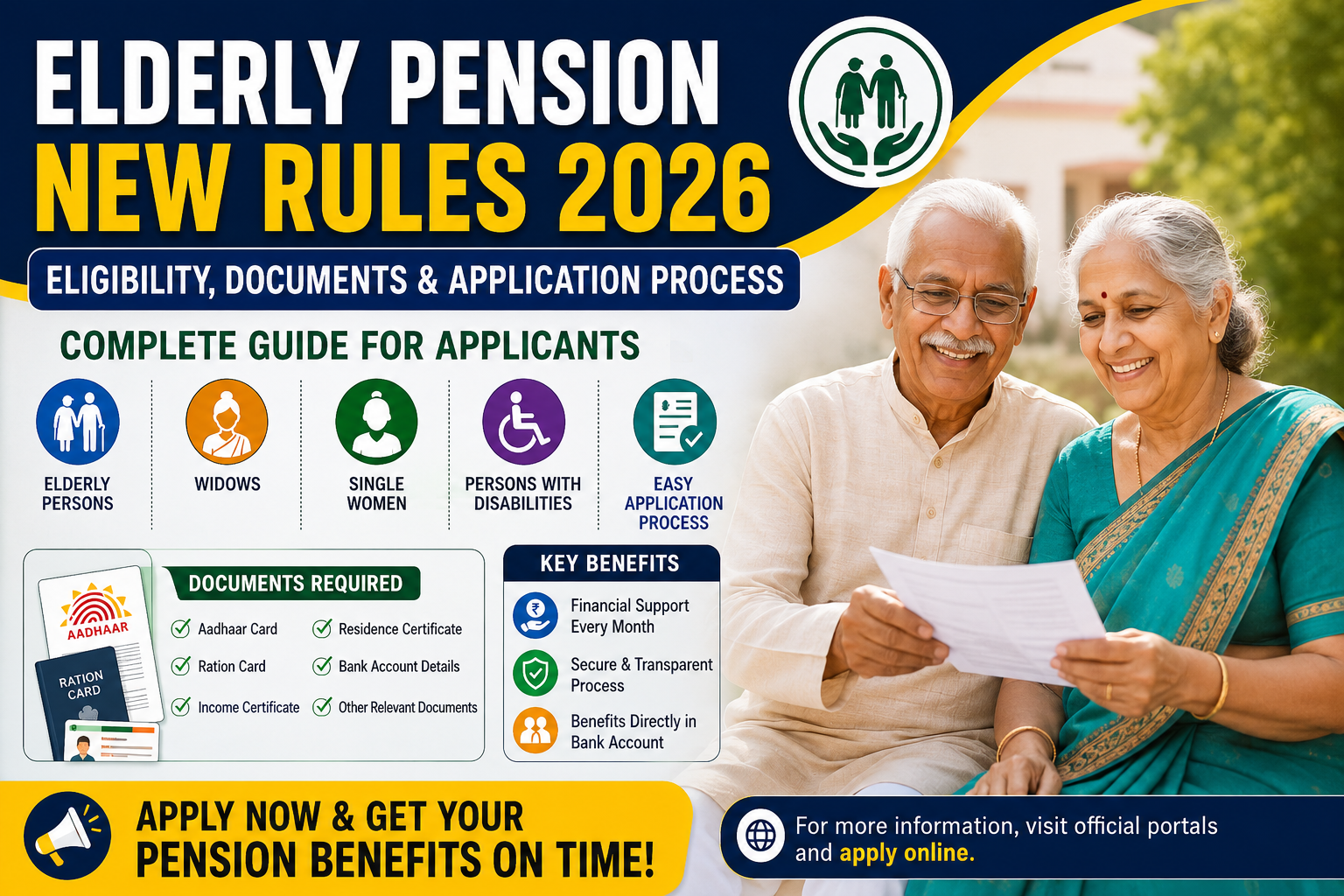

The government has introduced several updates under the Elderly Pension New Rules 2026 to improve transparency, simplify verification, and ensure that pension benefits reach eligible beneficiaries without delays.
These changes are expected to benefit senior citizens, widows, single women, and eligible persons with disabilities who depend on social welfare pensions for financial support.
In this article, we will explain the latest pension rules, eligibility criteria, required documents, application process, verification requirements, and important tips for applicants.
What Are the Elderly Pension New Rules 2026?
The Elderly Pension New Rules 2026 focus on strengthening beneficiary verification and reducing errors in pension distribution. Under the revised guidelines, applicants must ensure that their personal details match across all submitted documents.
Aadhaar-based verification and updated beneficiary records are expected to play a major role in the approval process.
The objective of these changes is to:
- Improve transparency in pension distribution.
- Prevent duplicate or fraudulent applications.
- Ensure timely pension payments.
- Simplify the application and verification process.
- Maintain accurate beneficiary records.
Who Can Apply?
The pension scheme is generally intended for eligible citizens who meet the prescribed conditions.
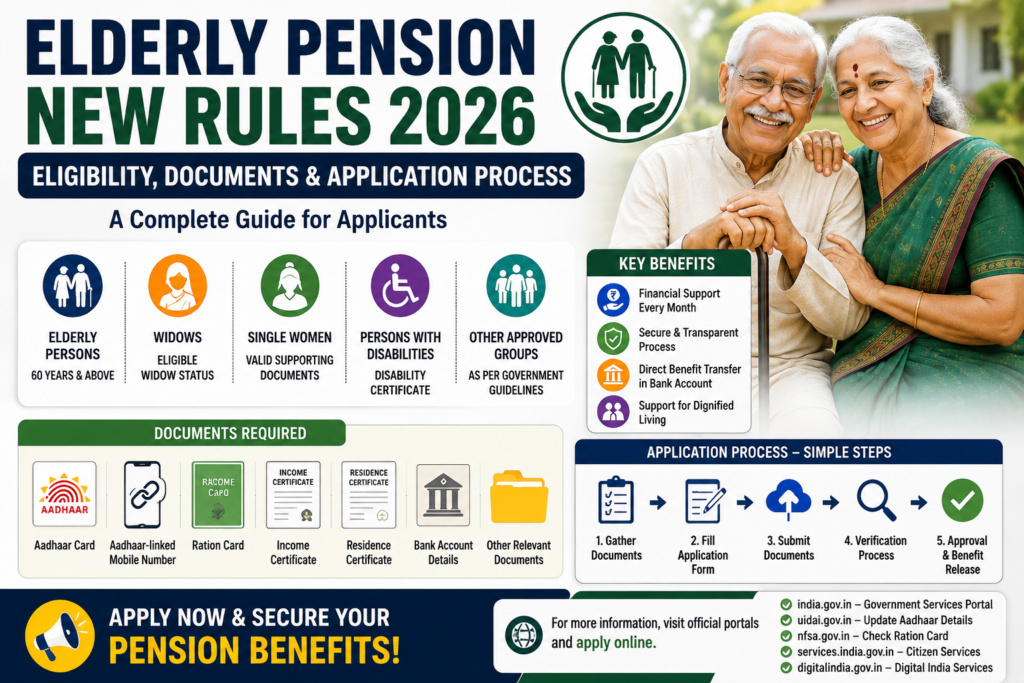
- Senior citizens aged 60 years and above.
- Widows meeting the eligibility requirements.
- Single women eligible under welfare provisions.
- Persons with disabilities who qualify under the scheme.
- Economically weaker individuals covered by social welfare programs.
Applicants should verify the specific eligibility conditions applicable in their state or local jurisdiction before applying.
👉 Read Also: LPG Gas New Rules June Update 2026
Eligibility Criteria
Age Requirement
Applicants must generally be at least 60 years old to qualify for elderly pension benefits.
Residency Requirement
The applicant should be a resident of the state or region where the pension application is being submitted.
Income Conditions
Many pension schemes are designed for economically weaker sections. Applicants may need to provide proof of income or demonstrate financial need.
Aadhaar Verification
A valid Aadhaar number is often required for identity verification and pension processing.
Documents Required
Applicants should keep the following documents ready before submitting their application.
1. Aadhaar Card
The Aadhaar Card serves as the primary identity document for verification purposes. If you need to update Aadhaar details before applying, visit Update Aadhaar Details.
2. Aadhaar-Linked Mobile Number
An active mobile number linked with Aadhaar helps receive OTPs, verification messages, and application updates.
3. Ration Card
The ration card may be used to verify household details and eligibility. Applicants can verify information through Check Ration Card Information.
4. Income Certificate
An income certificate may be required to establish eligibility under income-based criteria.
5. Residence Certificate
Proof of residence helps confirm that the applicant belongs to the relevant jurisdiction.
6. Bank Account Details
Applicants should provide accurate bank account information to receive pension payments directly through Direct Benefit Transfer (DBT).
7. Category-Specific Documents
Additional documents may be required for widows, persons with disabilities, or other special categories.
Importance of Matching Information Across Documents
One of the most important aspects of the new rules is ensuring consistency across all submitted documents.
- Name spelling is identical on all documents.
- Date of birth matches official records.
- Address details are accurate and updated.
- Aadhaar information corresponds with bank records.
- Mobile number linked to Aadhaar is active.
Any mismatch may result in delays during verification or rejection of the application.
Step-by-Step Application Process
Step 1: Gather Required Documents
Collect all necessary documents before starting the application process.
Step 2: Verify Aadhaar Details
Ensure that Aadhaar information is accurate and updated.
Step 3: Complete the Application Form
Fill out the pension application form carefully and provide correct information.
Step 4: Upload or Submit Documents
Attach all required supporting documents as instructed.
Step 5: Submit the Application
Review the application thoroughly before final submission.
Applicants can explore additional government services through Citizen Service Applications Portal.
Step 6: Verification Process
Authorities will verify the submitted information and documents.
Step 7: Approval and Pension Disbursement
Once approved, pension payments will be credited directly to the beneficiary’s bank account.
Common Reasons for Application Rejection
- Incorrect personal information.
- Mismatch between Aadhaar and bank records.
- Incomplete documentation.
- Invalid income certificate.
- Incorrect bank account details.
- Unverified mobile number.
- Duplicate applications.
Carefully reviewing all information before submission can help prevent unnecessary delays.
Benefits of the Updated Pension System
Faster Verification
Digital verification processes can reduce processing time.
Improved Transparency
Accurate beneficiary records help ensure fair distribution of benefits.
Direct Bank Transfers
Pension payments are transferred directly to beneficiaries.
Better Record Management
Updated records help authorities maintain accurate beneficiary databases.
Reduced Fraud
Enhanced verification measures help prevent misuse of welfare benefits.
Important Tips Before Submitting Your Application
- Check all documents for accuracy.
- Ensure Aadhaar details are updated.
- Verify bank account information.
- Keep photocopies and digital copies of documents.
- Use an active Aadhaar-linked mobile number.
- Review the application form carefully before submission.
For information about digital government services and welfare programs, visit Digital Government Services.
Applicants can also explore official citizen services through Apply Now – Government Services Portal.
Frequently Asked Questions (FAQs)
1.Who can apply for the Elderly Pension New Rules 2026?
People aged 60 years and above, widows, single women, and eligible persons with disabilities can apply.
2.What documents are required for pension verification?
Aadhaar Card, Aadhaar-linked mobile number, Ration Card, Income Certificate, and Residence Certificate are commonly required.
3.Can I apply if my Aadhaar and bank account names are different?
No. It is advisable to correct mismatched details before applying.
4.How can I check my pension application status?
You can check status through the official government portal or local welfare office.
5.Is an Aadhaar-linked mobile number mandatory?
Yes. It helps receive application updates and verification messages.
Conclusion
The Elderly Pension New Rules 2026 aim to make pension distribution more transparent, efficient, and beneficiary-focused.
By ensuring that all documents are accurate, Aadhaar details are updated, and eligibility requirements are met, applicants can improve their chances of receiving timely pension benefits.
Before submitting your application, carefully review all information, verify supporting documents, and follow the prescribed guidelines.
Staying informed about the latest pension rules can help eligible beneficiaries access financial assistance smoothly and without unnecessary delays.