
PM Kisan Scheme 2026 is a Central Government scheme that provides financial assistance to eligible farmer families across India. Under the scheme, beneficiaries receive ₹6,000 per year in three equal installments through Direct Benefit Transfer (DBT).
To receive benefits under PM-KISAN, farmers must complete Aadhaar verification, eKYC requirements, and provide valid land and bank account details. This guide explains eligibility criteria, required documents, registration steps, beneficiary status checking, payment details, and common reasons for application or payment delays.
What is PM Kisan Scheme 2026?
Pradhan Mantri Kisan Samman Nidhi (PM-KISAN) is a Central Government income support scheme for eligible landholding farmer families across India. Under the scheme, eligible beneficiaries receive financial assistance of ₹6,000 per year through Direct Benefit Transfer (DBT). The amount is released in three equal installments of ₹2,000 and credited directly to the beneficiary’s bank account. The annual assistance amount remains ₹6,000 in 2026.
The scheme is administered by the Department of Agriculture and Farmers Welfare under the Ministry of Agriculture and Farmers Welfare. Aadhaar-based verification, land record validation, and eKYC compliance play an important role in beneficiary approval and continued payment processing.
Key Benefits of PM Kisan Scheme
| Benefit | Details |
|---|---|
| Annual Financial Assistance | ₹6,000 per year |
| Installment Amount | ₹2,000 per installment |
| Number of Installments | 3 installments annually |
| Payment Method | Direct Benefit Transfer (DBT) |
| Beneficiaries | Eligible landholding farmer families |
| Application Mode | Online and authorized service centers |
Who Can Apply for PM Kisan?
PM-KISAN primarily supports eligible farmer families that own cultivable land and satisfy government eligibility requirements.
General Eligibility Conditions
- Applicant should belong to a landholding farmer family.
- Land records should be available and verifiable.
- Aadhaar details should be valid and updated.
- Bank account details should be active and linked correctly.
- eKYC requirements should be completed for continued benefits.
Who Is Not Eligible for PM Kisan?
Certain categories are excluded from receiving PM-KISAN benefits.
Common ineligible categories include:
- Institutional landholders.
- Income tax payers.
- Constitutional post holders.
- Serving or retired government officers under specified categories.
- Professionals such as doctors, engineers, architects, and lawyers who fall under notified exclusion categories.
Applicants should verify eligibility carefully before submitting registration requests.
Documents Required for PM Kisan Registration
The following documents are generally required during registration and verification:
| Document | Purpose |
| Aadhaar Card | Identity verification |
| Land Ownership Documents | Landholding verification |
| Bank Passbook | DBT payment verification |
| Mobile Number | OTP and communication |
| Passport Size Photograph | Registration records |
| Residence Proof | Address verification |
Before applying, applicants should ensure that all records contain matching personal information. Name mismatches between Aadhaar, land records, and bank accounts can lead to delays or rejection.
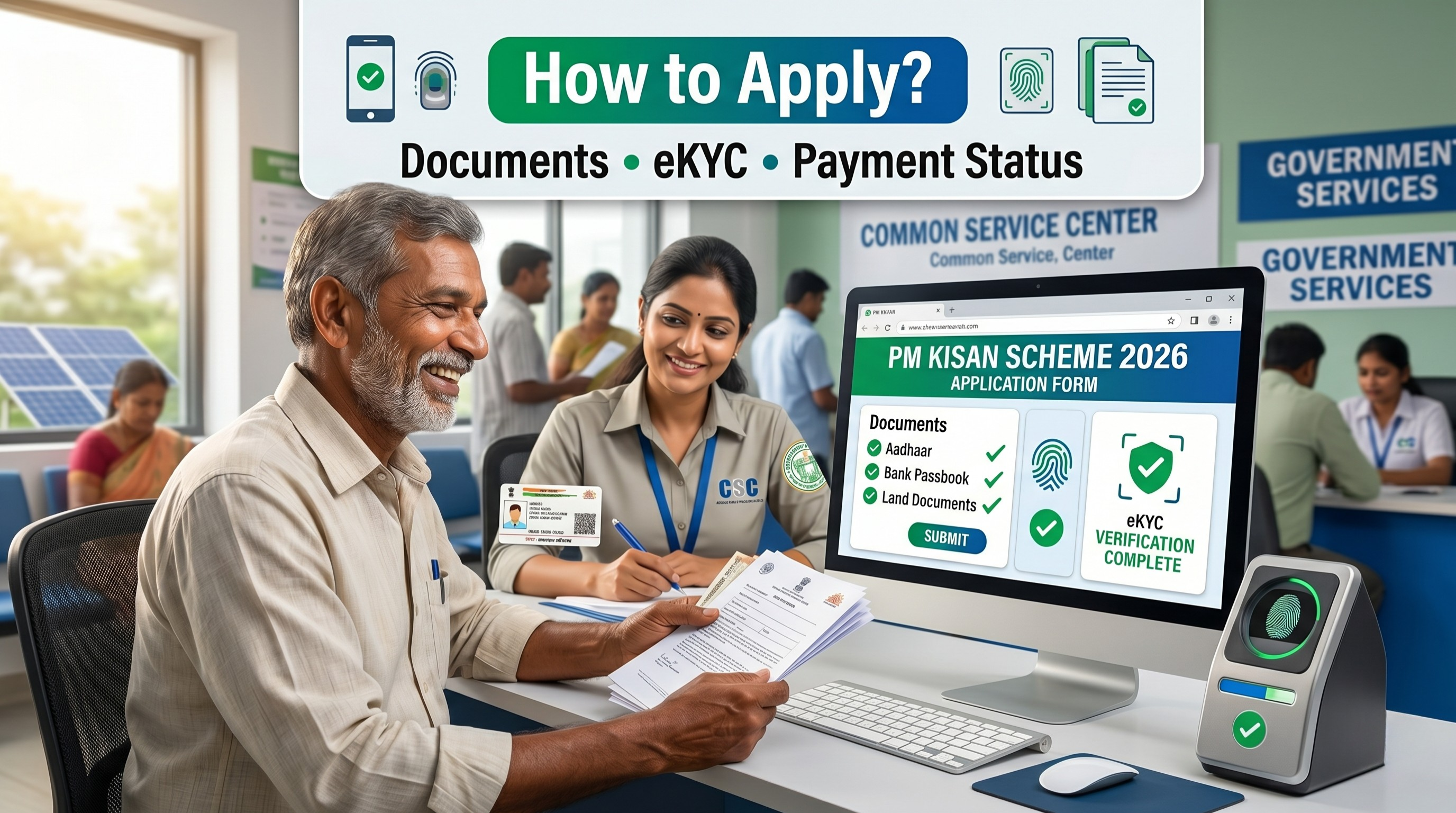
How to Apply for PM Kisan Scheme
Online Registration Process
Eligible farmers can register through the official PM-KISAN portal.
Registration Steps
- Visit the official PM-KISAN portal.
- Select “New Farmer Registration.”
- Enter Aadhaar number.
- Complete Aadhaar authentication.
- Fill personal information.
- Enter landholding details.
- Submit bank account information.
- Complete registration and save the reference number.
What Happens After Registration?
Many applicants are unaware that registration is only the first stage.
After submission, applications generally move through the following stages:
- Aadhaar authentication.
- Land record verification.
- Beneficiary validation.
- State-level verification.
- Approval by the competent authority.
- Beneficiary database update.
- Installment processing.
- DBT payment release.
Applications may remain pending until all verification stages are completed successfully.
Why eKYC Is Important
eKYC is mandatory for PM-KISAN beneficiaries. Farmers who fail to complete eKYC may face payment interruptions or installment delays. The government provides OTP-based, biometric-based, and face-authentication-based eKYC options through authorized channels.
eKYC Benefits
- Faster verification.
- Reduced payment delays.
- Improved beneficiary authentication.
- Continued eligibility for future installments.
Common Reasons for PM Kisan Application Rejection
Applications may be rejected or kept pending due to verification issues.
Common reasons include:
- Aadhaar and bank account name mismatch.
- Incorrect bank account details.
- Invalid IFSC code.
- Incomplete eKYC.
- Land records not matching government databases.
- Duplicate beneficiary records.
- Incorrect personal information.
- Ineligible applicant category.
Common Reasons for Installment Delays
Some farmers are approved but still experience payment delays.
Typical reasons include:
- Pending eKYC verification.
- Aadhaar authentication issues.
- Bank account problems.
- Incorrect beneficiary details.
- Land verification pending.
- State-level verification delays.
How to Check PM Kisan Beneficiary Status
Beneficiaries can track application and payment information through the official PM-KISAN portal.
Required Information
- Registration Number
- Aadhaar Number
- Registered Mobile Number
Status Check Process
- Open the PM-KISAN portal.
- Select “Know Your Status.”
- Enter Registration Number.
- Complete OTP verification.
- View beneficiary details, installment history, and payment status.
How to Check PM Kisan Beneficiary List
Farmers can also verify whether their names appear in the approved beneficiary list.
Steps
- Visit the PM-KISAN portal.
- Open “Beneficiary List.”
- Select State.
- Select District.
- Select Sub-District.
- Select Block.
- Select Village.
- Click “Get Report.”
Official Links
| Resource | Official Link |
| PM-KISAN Official Portal | https://pmkisan.gov.in |
| New Farmer Registration | https://pmkisan.gov.in |
| Beneficiary Status | https://pmkisan.gov.in/beneficiarystatus_new.aspx |
| Beneficiary List | https://pmkisan.gov.in/rpt_beneficiarystatus_pub.aspx |
| eKYC Services | https://pmkisan.gov.in/KnowAboutEKYC.aspx |
Important Tips for Applicants
- Complete eKYC immediately after registration.
- Ensure Aadhaar and bank details match.
- Keep land records updated.
- Use an active mobile number.
- Verify beneficiary status regularly.
- Respond quickly to correction requests.
- Avoid duplicate registrations.
Frequently Asked Questions
1.How much financial assistance is provided under PM-KISAN?
Eligible beneficiaries receive ₹6,000 annually in three installments of ₹2,000 each.
2.Is eKYC mandatory?
Yes. eKYC is mandatory for continued benefit processing under PM-KISAN.
3.Can I check beneficiary status online?
Yes. Beneficiaries can check their status through the official PM-KISAN portal.
4.Why is my installment delayed?
Common reasons include incomplete eKYC, Aadhaar mismatch, incorrect bank details, and pending verification.
5.Can bank details be corrected?
Beneficiaries can request corrections through authorized channels if submitted bank details are incorrect.
6.Is Aadhaar required for registration?
Aadhaar authentication is an important part of the registration and verification process.
Conclusion
PM-KISAN continues to be one of India’s largest farmer support programs, providing direct income assistance to eligible landholding farmer families. Applicants should ensure that Aadhaar information, land records, bank details, and eKYC requirements are completed correctly to avoid delays in approval and installment payments. Regular status checks and timely correction of verification issues can help beneficiaries receive assistance without interruption.

Venkatesh is the Content Lead and Researcher at UNQ Information. He researches government schemes, pension programs, citizen services, and welfare initiatives related to Andhra Pradesh and Telangana. He regularly publishes updates and educational content to help readers understand eligibility criteria, required documents, application procedures, benefit details, and important government announcements in a simple and easy-to-understand format.